
Thousands of plant species have evolved remarkable abilities to survive—even thrive—in salty environments where most vegetation withers and dies. These halophytes aren’t just botanical oddities—they might be agriculture’s secret weapon against rising seas and soil salinization. Not that farmers are exactly rushing to plant them. Yet.
These salt-loving plants employ impressive tricks. Some simply block salt at the root level, refusing entry like bouncers at an exclusive club. Others let salt in but sequester it in vacuoles—basically cellular trash bins—keeping their metabolic machinery salt-free. Smart move. Many halophytes sport special glands that actively secrete excess salt onto leaf surfaces. It’s like sweating, but with sodium chloride instead of water. Gross but effective.
Nature’s salt-busting engineers: blocking, sequestering, and sweating away sodium that would kill lesser plants.
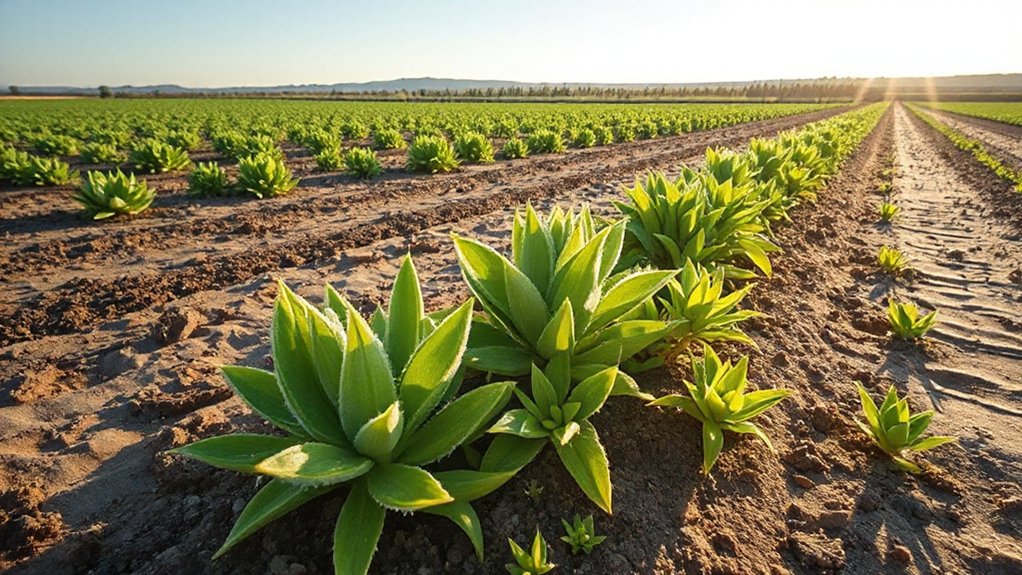
Morphologically, these plants aren’t winning beauty contests. Thick, waxy leaves. Succulent stems. Deep, sprawling roots. They’re built for survival, not Instagram. Their compact growth and reduced leaf area minimize exposure to salt spray. Function over form, every time.
Ecologically, salt-tolerant plants are superstars. Dune grasses like Ammophila literally hold coastlines together during storms. Mangroves trap sediments and store carbon like nobody’s business. They create habitat for countless species. The Japanese Pittosporum is particularly valuable in coastal landscaping due to its adaptability to coastal conditions. Junipers are exceptionally valuable in these environments thanks to their year-round greenery that provides consistent structure in harsh coastal landscapes. No halophytes, no fisheries. It’s that simple.
The agricultural applications are where things get interesting. Quinoa, barley, and certain sorghums already tolerate moderate salinity. Salicornia—sometimes called sea asparagus—grows in pure seawater and is edible. Delicious, even.
Researchers are busy transferring salt-tolerance genes into conventional crops. Farmers in coastal areas are experimenting with agroforestry using salt-tolerant trees as windbreaks and buffers.
Is this the future of farming? Maybe. As arable land shrinks and seas rise, we might not have a choice. Salt-loving plants won’t save agriculture overnight. But they offer something increasingly precious in coastal regions: options.
And in a warming world with encroaching seas, options are exactly what farmers need.
References
- https://lawnlove.com/blog/best-salt-tolerant-plants/
- https://www.gardenia.net/plants/tolerance/salt
- https://pollution.sustainability-directory.com/term/salt-tolerant-plants/
- https://toptropicals.com/store/tag/salt.htm
- https://hort.extension.wisc.edu/articles/winter-salt-injury-and-salt-tolerant-landscape-plants/
- https://www.arboretum.purdue.edu/explorer/plant_special_chars/slt/
- https://grownative.org/salt-tolerant-native-plants/
- https://www.bloomindesigns.com/salt-tolerant-plants/
- https://asknature.org/strategy/wild-relatives-confer-salt-tolerance/
- https://watereuse.org/salinity-management/cp/cp_2.html