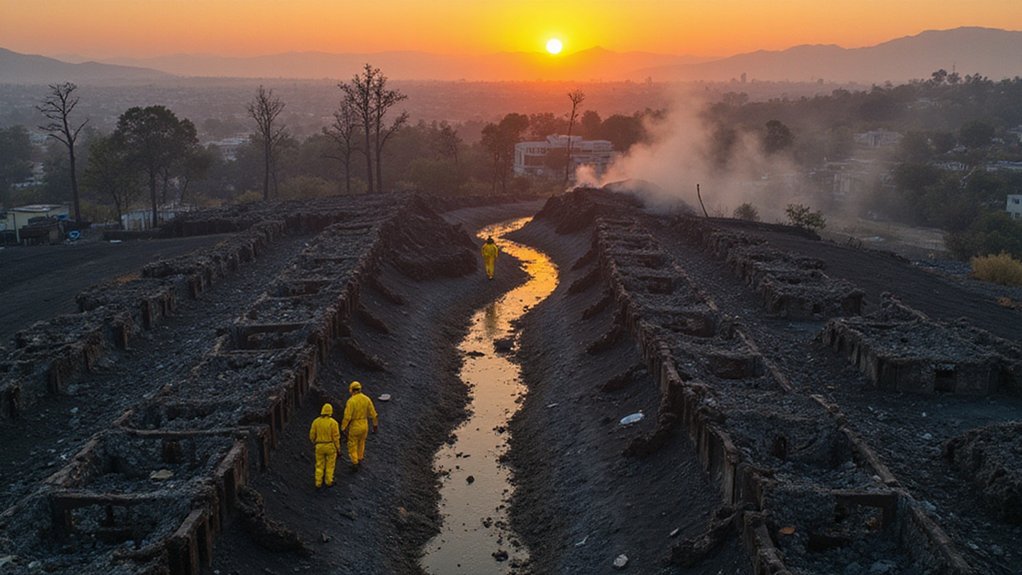
When the January 2025 LA wildfires torched over 16,000 structures and killed 29 people, they left behind more than just ash and heartbreak. They created a toxic wasteland that scientists are scrambling to understand before millions of residents return home.
The numbers are grim. Volatile organic compounds inside damaged homes measure four to five times higher than outside levels. That’s not a typo. Five times. These aren’t your garden-variety pollutants either. We’re talking dioxins, furans, and polycyclic aromatic hydrocarbons from incinerated buildings, cars, and that expensive couch you loved.
Heavy metals, asbestos, benzene, PCBs, and flame retardants all mixed together in a devil’s cocktail of fire debris. The fires exposed millions to these toxins plus PFAS chemicals, those “forever chemicals” that don’t break down and accumulate in your body over time.
The health impacts read like a medical horror story. Acute respiratory symptoms hit first. Then come the neurological effects—headaches, cognitive issues, the works. Your cardiovascular system takes a beating too, with increased risks of heart disease and stroke. Long-term? Scientists worry about immune system disruption, reproductive health problems, and cancer. Fun times ahead.
Here’s the kicker: this toxic mess doesn’t stay put. Winds exceeding 70 miles per hour whipped contaminated ash hundreds of miles downwind. Sure, the wind helped clear the smoke, but it also spread the poison around like a demented fairy godmother.
Particulate matter—both PM2.5 and PM10—penetrates deep into lungs and enters the bloodstream. Similar to the extreme weather events we’re seeing globally, these fires create cascading environmental and health crises that extend far beyond the burn zones. Coastal waters aren’t safe either, threatened by toxic runoff that’ll stick around for years.
Scientists launched a multi-institutional study to examine these health impacts, collecting data for special issue papers. They’re studying contamination in air, water, and soil, trying to figure out how people can safely rebuild. The Spiegel Family Fund bankrolled this 10-year investigation, bringing together experts from Harvard, UCLA, UC Davis, and UT Austin.
The South Coast Air Quality Management District issued dust advisories. N95 masks became the new fashion accessory. Windows stayed shut.
The research aims to help residents eventually return, but the contamination in burn scars may pose threats for years. While scientists race against time, millions of Los Angeles residents wait, wondering if their neighborhoods will ever truly be safe again.
The fires stopped burning, but their toxic legacy is just beginning.
References
- https://insideclimatenews.org/news/25052025/scientists-study-la-fire-toxins/
- https://www.waterboards.ca.gov/water_issues/programs/emp/wildfire_recovery/
- https://cockrell.utexas.edu/news/archive/10130-long-term-multi-institutional-study-on-health-impacts-of-los-angeles-wildfires-launched
- https://axial.acs.org/earth-space-and-environmental-chemistry/call-for-papers-the-2025-los-angeles-fires
- https://www.latimes.com/environment/story/2025-01-16/la-wildfire-smoke-impacts