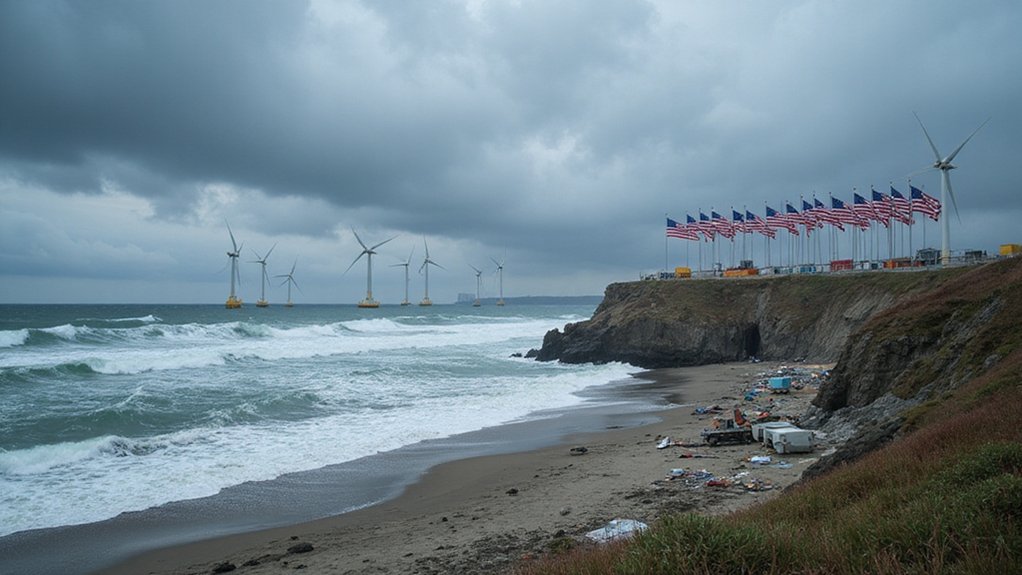
The U.S. Department of Interior’s $2.3B Marine Minerals Administration is raising concerns about its potential impact on decades of established offshore regulation. Critics say the move could shake up more than 50 years of rules that govern how the country manages its ocean resources. The agency hasn’t directly addressed those concerns yet.
The Department of Energy’s FY 2022 budget request totals $27.755B across several programs. A large chunk of that, $19.7B, goes toward sustaining and modernizing the U.S. nuclear stockpile and nuclear Navy. Meanwhile, $2.3B is designated for Basic Energy Sciences to support fundamental research on matter control.
The Bureau of Ocean Energy Management, known as BOEM, plays a key role in overseeing offshore areas. It’s been focused heavily on offshore wind development under the Biden administration. BOEM recently resumed its environmental review of the 800-megawatt Vineyard Wind project off Massachusetts. The agency’s also working to maximize offshore wind benefits in regions like Southern Oregon and Northern California.
The U.S. government has set ambitious goals to add 30 gigawatts of offshore wind capacity by 2030. Alongside wind, research is supporting carbon capture, geothermal energy, and critical minerals recovery from coal waste. The DOE’s Fossil Energy and Carbon Management program received $890M to focus on clean energy and rebuilding the country’s critical minerals supply chain. Analysts note that battery storage costs have dropped 90% over the past decade, further accelerating demand for critical minerals used in energy storage systems.
Offshore mineral extraction hasn’t been a visible part of Guam’s ocean economy. There’s also no direct evidence linking the $2.3B figure to any specific plan that would upend existing offshore regulation. No explicit regulatory threat has been identified in either the budget documents or BOEM’s official records. BOEM also recently offered the first marine renewable energy research lease in federal waters off the U.S. West Coast to Oregon State University for the PacWave South project.
The DOE’s budget also includes $7.6B for the Environmental Management program, which handles cleanup of Manhattan Project and Cold War nuclear sites. Savannah River’s Liquid Waste Program received $978M. The Office of River Protection got $1.5B for cleanup work under an Amended Consent Decree.
Isotope production received $90M to secure supply chains for emerging technologies. The full picture of how these funding decisions might reshape offshore rules remains unclear.
References
- https://www.energy.gov/sites/default/files/2021-06/doe-fy2022-budget-in-brief-v3.pdf
- https://cbe.miis.edu/cgi/viewcontent.cgi?article=1008&context=publications
- https://www.powermag.com/boem-bolstered-by-biden-offshore-wind-agenda-resumes-vineyard-wind-review/
- https://www.boem.gov/sites/default/files/documents/BOEM-2023-067.pdf
- https://onelagoon.org/wp-content/uploads/FINAL-Technical-Report-2025-02b-Economic-Valuation_The-Balmoral-Group-202511.pdf
- https://totalenergies.com/system/files/documents/totalenergies_universal-registration-document-2025_2026_en.pdf