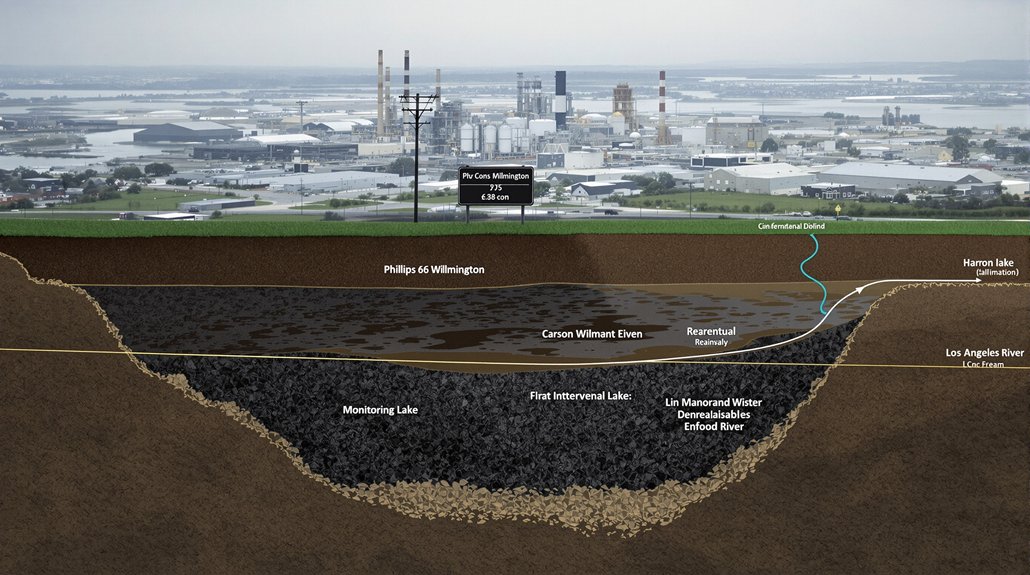
Beneath the sprawling cityscape of Los Angeles lies a hidden menace that few residents even know exists. An enormous underground oil lake has formed beneath portions of Wilmington and Carson, primarily around the Phillips 66 refinery. We’re not talking about a small puddle here. In some spots, this toxic sludge measures a whopping 16 feet thick. That’s nearly the height of a two-story building, just sitting there underground.
Los Angeles hides a toxic secret: a massive underground oil lake lurking beneath neighborhoods, thick enough to submerge a two-story house.
The scope is mind-boggling. Imagine 480 Olympic swimming pools filled with oil and refinery waste. Yeah, that much. Workers spent almost 40 years in the mid-1900s just burying this stuff directly into the ground. Dump and forget – what could possibly go wrong?
It’s not just the refinery sites causing problems. The Los Angeles Basin contains 68 named oil fields, some of the most productive in the world. Many of the 1,250 wells in the LA City Oil Field weren’t properly plugged when abandoned. The field once produced over 1.8 million barrels in 1901 during its peak year with approximately 1,150 active wells. These ticking time bombs now sit uncomfortably close to homes – on average, just 29 feet away in some neighborhoods. Over 100 wells are within 25 feet of residential buildings. Sleep tight, folks!
Communities near these sites suffer disproportionately, with higher environmental and health burdens than 83% of other Californians. When it rains, contaminants can wash toward the Los Angeles River and eventually reach the ocean. Nice.
The cleanup challenges are massive. Phillips 66 is technically responsible, but they’re also the ones estimating the costs. Convenient, right? Meanwhile, federal funding for remediation has been slashed, leaving fewer resources for oversight. Environmental testing has revealed dangerous tert-butyl alcohol in monitoring wells since 2008, threatening nearby drinking water sources.
Corporate accountability remains murky at best. Decades of regulatory neglect allowed this toxic legacy to grow unchecked. Now, with competing land use priorities and limited public funding, the underground lake continues to threaten LA’s future. Someone will eventually pay for this mess – but nobody’s volunteering for the job.
References
- https://en.wikipedia.org/wiki/Los_Angeles_City_Oil_Field
- https://laist.com/news/climate-environment/phillips-66-oil-refinery-closure-cleanup
- http://carbonacea.blogspot.com/2015/08/los-angeles-basin-most-prolific-and.html
- https://en.wikipedia.org/wiki/Aliso_Canyon_Oil_Field
- https://www.fractracker.org/2025/03/environmental-justice-analysis-of-oil-extraction-in-los-angeles-communities/