While Detroit once dominated the global auto industry through gas-guzzling behemoths, its future now hinges on batteries—lots of them.
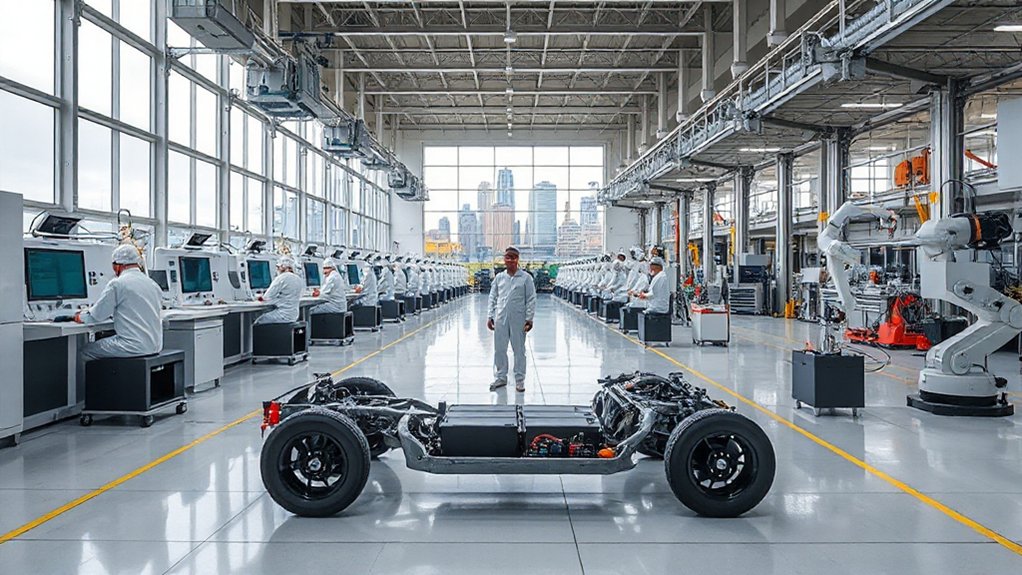
The Great Lakes region’s battery manufacturing capacity is set to explode from a measly 37 GWh to a whopping 285 GWh per year by 2026. That’s enough juice to power hundreds of thousands of EVs. Ford alone wants to crank out 2 million electric vehicles by 2026, up from the relatively pathetic 132,000 it managed in 2022. Ambitious? You bet.
The money being thrown around is staggering. Private companies have announced $133 billion in EV and battery investments nationwide under Biden. Michigan‘s gone all-in, committing $1 billion across five battery plant proposals with promises of another billion to come. They’re practically begging automakers to stay local.
GM snagged $468 million from Michigan’s incentive package. Ford initially scored a $1.7 billion deal before the state slashed it by 60% after Ford downsized its plans. Money talks.
But here’s the reality check: more than half of Michigan’s manufacturing projects announced since 2019 have been canceled. Ford scaled back its Michigan battery plant from 35 GWh to 20 GWh. GM sold its stake in the Lansing Ultium plant to LG and halted production at Orion Township. The EV revolution isn’t exactly firing on all cylinders.
Jobs? Not materializing as promised. GM has laid off over 3,400 workers at EV and battery plants. Cooling demand hurts. Michigan even clawed back $100 million from Ford for missing job targets.
Still, the region has advantages. Detroit has invented nearly three times more EV-related patents than any other U.S. city in the past six years. Six of the top ten cities specializing in EV patents are in the Great Lakes region. The development of robust lithium-ion battery supply chains remains critical to maintaining this competitive edge. As battery storage costs are expected to decrease by 52% by 2030, Michigan’s investments could eventually align with market realities. Governor Whitmer continues emphasizing EV supply chains as central to Michigan’s economic future despite the setbacks.
The numbers tell the story. North American BEV production will rise from 7.9% to 8.9% of total vehicle production between 2025 and 2026.
That’s progress, but hardly revolutionary. Detroit’s betting big on batteries. Will it pay off? The jury’s still out.
References
- https://rmi.org/electric-vehicle-battery-manufacturing-in-the-great-lakes-region/
- https://pv-magazine-usa.com/2025/08/19/are-evs-booming-or-idling-in-detroit/
- https://bridgemi.com/business-watch/michigans-1b-bet-evs-has-produced-few-jobs-should-lawmakers-double-down/
- https://www.fastmarkets.com/insights/ev-pivot-by-automakers-will-likely-drive-2026-us-auto-production-trends-analysts/
- https://atlaspolicy.com/wp-content/uploads/2025/01/Tracking-the-State-of-U.S.-EV-Manufacturing.pdf
- https://www.wardsauto.com/news/gm-layoffs-ultium-cells-factory-zero/804171/
- https://reccessary.com/en/news/america-falling-behind-global-EV-race