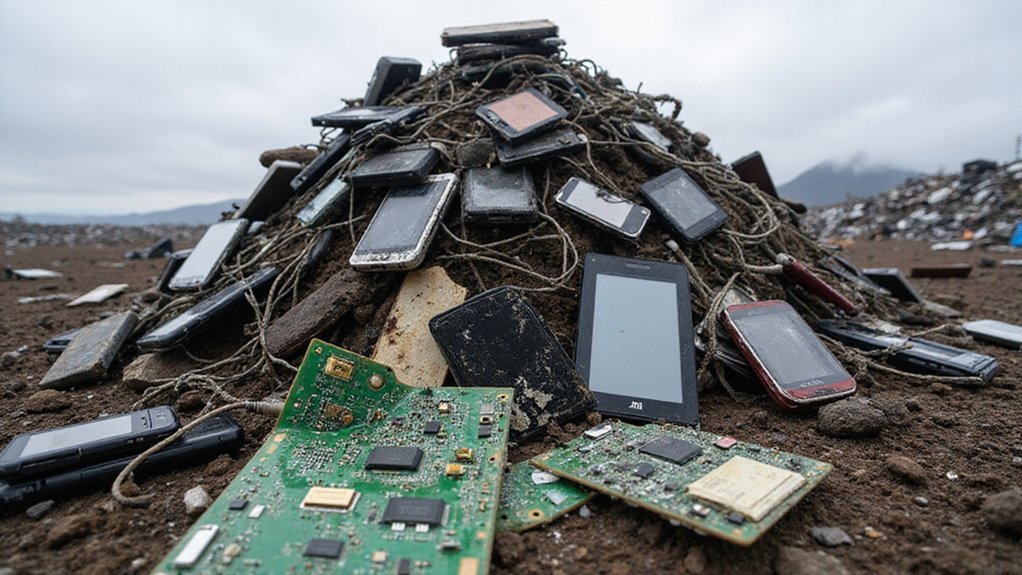
Millions of old solar panels are piling up across the United States, and the country doesn’t have enough recycling plants to handle them. Between 10 and 25 million panels are expected to retire every year by 2030. But right now, only about 10% of retired panels actually get recycled, by some accounts.
Only 10% of retired solar panels get recycled — and millions more are set to pile up by 2030.
The numbers behind this problem are big. The US had around 279 gigawatts of solar capacity operating by the end of 2025. Most of those systems were installed after 2017. Solar panels last 20 to 30 years, which means a massive wave of old panels is coming. About 30 to 35 million panels are expected to retire in the US by 2030 alone.
The recycling industry isn’t ready. Only a handful of companies currently process used panels. Six recyclers combined can handle somewhere between 1,000 and 50,000 tons per year. Experts say at least ten plants would be needed just to deal with the 2030 retirement volume.
SOLARCYCLE is scaling up to process one million panels annually by the end of 2026. Hanwha Qcells EcoRecycle can reportedly handle up to 250 megawatts of panels each year. First Solar processes 150 metric tons of thin-film modules per day, but it only handles its own products.
There’s real money sitting in those old panels. By 2030, decommissioned panels in the US could hold around $450 million worth of recoverable materials like silicon and silver. That figure is projected to jump to $15 billion by 2050, enough to manufacture two billion new panels. Twelve to thirteen percent of the world’s mined silver goes into solar panels, embedding substantial value in every retired module.
The global recycling market is expected to grow from $333.5 million in 2024 to $2.4 billion by 2034. Globally, the IEA PVPS estimates cumulative PV module waste could reach roughly 60 to 78 million tons by 2050, underscoring just how urgent the recycling capacity gap will become. Solar panels share a similar recycling challenge with wind turbines, whose blades are made from composite materials that resist separation and complicate end-of-life processing.
Rules around solar panel recycling are still catching up. There’s no federal law requiring it. Washington State has required manufacturers to fund takeback programs since 2017. California treats old panels as universal waste. New Jersey set up a Solar Panel Recycling Commission in 2024.
The EPA is expected to issue a ruling that could simplify how retired panels are handled nationwide. Until then, a patchwork of state rules is making things complicated for businesses trying to comply.
References
- https://www.pv-tech.org/a-billion-dollar-industry-inside-the-growing-solar-panel-recycling-sector-in-the-us/
- https://www.datamintelligence.com/research-report/solar-panel-recycling-market
- https://www.solarpowerworldonline.com/2026/03/with-great-solar-power-comes-great-recycling-responsibility/
- https://www.solarcycle.us/resources/celebrating-another-year-turning-retired-solar-panels-into-the-materials-of-tomorrow
- https://www.canarymedia.com/articles/clean-energy-manufacturing/us-solar-manufacturing-in-2026
- https://www.datainsightsmarket.com/reports/solar-panel-recycling-1407433
- https://www.grandviewresearch.com/industry-analysis/solar-panel-recycling-market
- https://www.nrucfc.coop/content/solutions/en/stories/energy-tech/solar-recycling–a-burden-or-opportunity.html