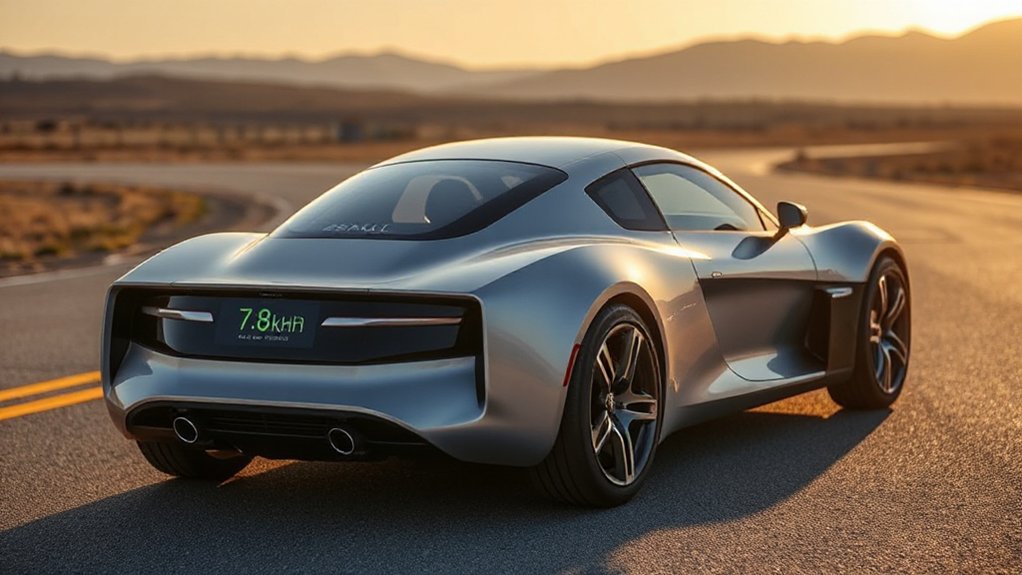

While most EVs tip the scales like oversized refrigerators on wheels, Renault’s Filante Record prototype has slashed the weight problem with a vengeance. The French automaker has managed to trim this sleek machine down to just 1,000 kg—practically anorexic by electric vehicle standards. How’d they do it? Carbon fiber. Aluminum alloys. Smart engineering. No more mechanical linkages thanks to steer-by-wire and brake-by-wire systems. Every gram counts.
Renault’s Filante Record EV shreds the weight problem at just 1,000 kg—proving efficiency doesn’t require excess.
The results speak for themselves: 626 miles on a single charge at 63 mph. Not creeping along like a turtle, but actually driving at highway speeds. Like, usable range. The kind that doesn’t leave you hunting for chargers every couple hours. Renault’s standard 2025 models will also focus on efficiency with 52kWh battery options offering up to 248 miles of range.
Aerodynamics play the starring role here. The Filante stretches 5.12 meters long but stands just 1.19 meters tall—fundamentally a carbon fiber pancake with wheels. Those wheels, by the way, were specifically designed to minimize air turbulence. The slender proportions create smoother airflow and reduced drag, critical for sustained efficiency at speed. Its design draws inspiration from historic speed record vehicles, creating a streamlined shape that cuts through air resistance.
Under its featherlight skin lies an 87 kWh battery pack developed by Ampere. No bulky modular design here—cells integrate directly into the pack. The carbon-cased power unit weighs in at about 600 kg, with a width of 1.71 meters. It’s fundamentally a bespoke energy sandwich built for maximum density in minimum space.
The drivetrain itself prioritizes cruising efficiency over neck-snapping acceleration. Motor architecture, regenerative braking, and electronics were all calibrated for steady highway speeds rather than stoplight drag races. Even the inverters were selected specifically for their high efficiency at sustained power levels. These advancements mirror the broader energy revolution occurring in transportation as renewable technologies become increasingly affordable and efficient.
Let’s be real—most production EVs will never match these numbers. But Renault’s proving what’s possible when weight, aerodynamics and efficiency take priority over massive battery packs. Sometimes less really is more. Especially when that “less” gives you 626 miles of driving range.
References
- https://www.goodwood.com/grr/road/news/2025-renault-5-e-tech-price-range-and-specs/
- https://www.autocar.co.uk/car-news/new-cars/renault-shoots-ev-range-record-new-filante-concept
- https://www.thedrive.com/news/this-wild-renault-concept-ran-for-626-miles-at-60-mph-on-one-charge-tds
- https://dmargecars.com/news/renaults-wild-single-seater-ev-drives-626-miles-at-highway-speed-on-one-charge
- https://www.automobile-catalog.com/car/2025/3316355/renault_5_e-tech_electric_techno_150_comfort_range.html
- https://www.evspecifications.com/en/model/7097387
- https://www.evspecifications.com/en/model/387f386