
While scientists have long debated solutions to our climate crisis, seaweed might just be the unsung hero we’ve been ignoring.
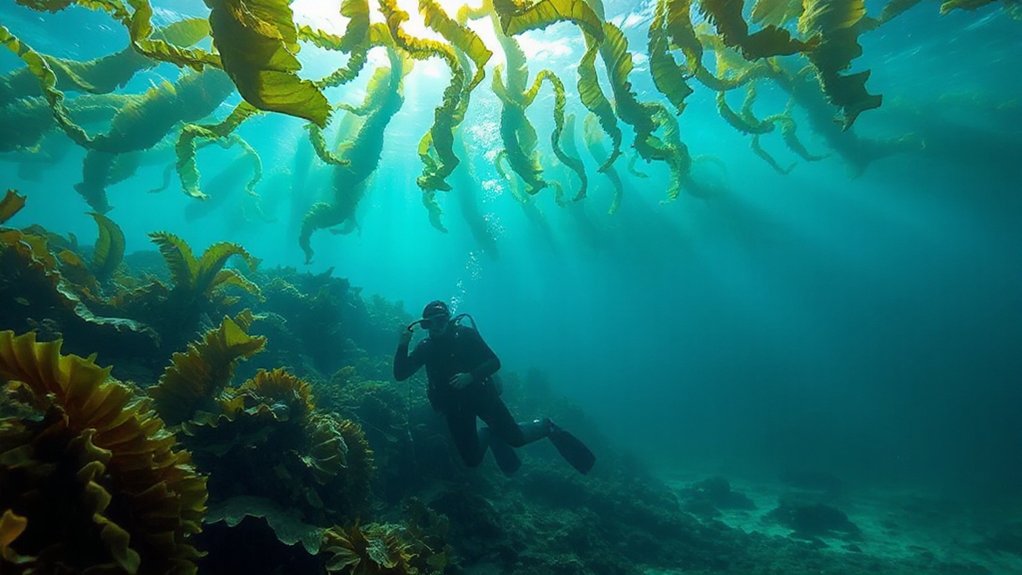
It’s not just pretty ocean decor. These underwater forests are carbon-capturing powerhouses that could revolutionize how we think about climate solutions. Seriously. They’re like trees, but wetter and arguably more efficient.
Forget ornamental algae—these submerged forests are climate game-changers, like trees with superpowers and swimsuits.
Seaweed farms are carbon transformation factories. Through photosynthesis, macroalgae convert dissolved CO₂ and bicarbonate into organic carbon. This process draws down inorganic carbon from surface waters, triggering a chain reaction. As CO₂ levels drop in the water, more atmospheric carbon dioxide dissolves into the ocean. Mother Nature’s own carbon capture system. No fancy technology required.
But here’s where it gets interesting. Below these farms, something magical happens in the muck. Anaerobic sediments convert organic carbon into bicarbonate alkalinity, effectively raising the pH.
This isn’t just good for marine life—it’s climate gold. This bicarbonate production prevents remineralized carbon from escaping back to the atmosphere as CO₂. Instead, it creates a centuries-long carbon storage solution. Talk about playing the long game.
The pathways for long-term storage are diverse. Detached seaweed can sink naturally to deep waters. Harvested biomass can become biochar or bioplastics. Some fragments reach deep sediments and get buried for millennia. It’s not just temporary storage—it’s practically permanent on human timescales.
The bonus? These farms offer a buffet of co-benefits. They ameliorate local ocean acidification, creating healthier marine environments. They remove excess nutrients from coastal waters. They enhance biodiversity. Much like renewable energy sources, seaweed farming represents a sustainable solution that doesn’t deplete finite resources. They even filter out heavy metals. Understanding these environmental implications is crucial for developing sustainable marine ecosystem management strategies. With production reaching 25 million tons in 2020, primarily from Indonesia and the Philippines, seaweed farming has already proven its viability at significant scale. Who doesn’t love a multitasker?
In the grand scheme of climate solutions, seaweed farming isn’t just promising—it’s revolutionary.
References
- https://phys.org/news/2026-01-seaweed-farms-boost-term-carbon.html
- https://oceanvisions.org/macroalgal-cultivation/
- https://www.edf.org/sites/default/files/2022-10/Carbon Sequestration by Seaweed.pdf
- https://news-oceanacidification-icc.org/2025/07/03/seaweed-responses-to-ocean-acidification-global-impacts-on-growth-biochemical-composition-and-co2-mitigation-potential/
- https://www.etcgroup.org/content/why-sinking-seaweed-not-answer-climate-change
- https://www.science.org/content/article/can-dumping-seaweed-sea-floor-cool-planet-some-scientists-are-skeptical
- https://pubs.acs.org/doi/10.1021/acs.chemrev.5c00433
- https://permies.com/t/193828/Carbon-Sequestration-grow-sink-seaweed