While critics initially scoffed at New York City’s congestion pricing scheme, the program has delivered undeniable results. The numbers don’t lie. PM2.5 particulate pollution dropped a whopping 22% in Manhattan‘s Congestion Relief Zone during the first six months of 2025. That’s not a typo—22 percent. Air monitors don’t have political agendas.
The improvement translated to a 3.05 microgram per cubic meter reduction in daily maximum PM2.5 concentrations. For context, experts predicted levels would have hit 13.8 micrograms without the program. And this isn’t based on fuzzy math—42 air quality monitors across the metro area collected 17,758 observations over 518 days. Science, folks.
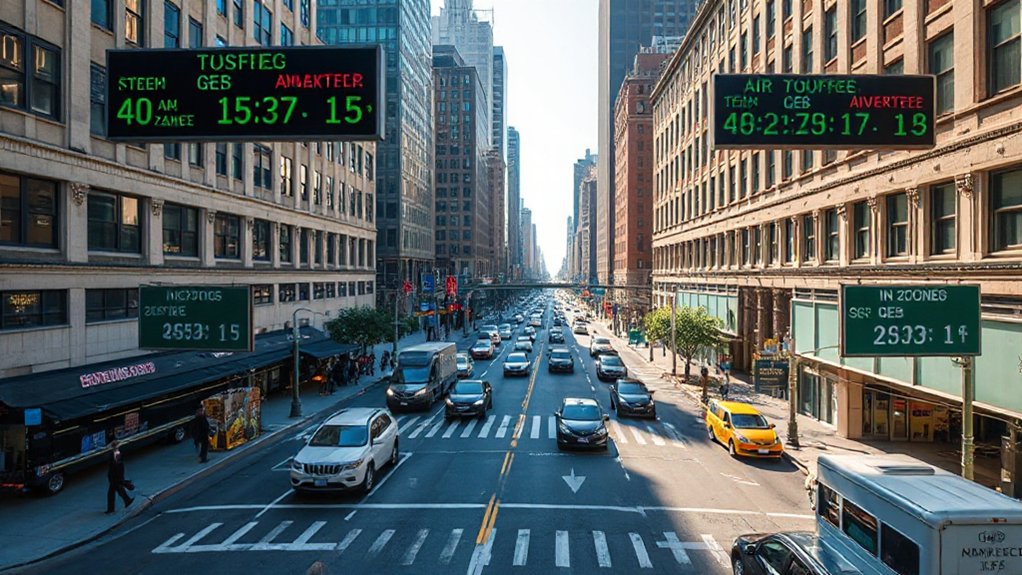
Vehicle volume tells the same story. The $9 toll drove an 11% decrease in traffic during peak hours, with 71,500 fewer vehicles entering the zone daily. That’s nearly 24 million fewer vehicles over eleven months. Fewer cars, fewer problems. Who knew?
The benefits spread beyond Manhattan’s borders. The five boroughs saw pollution drop by 1.07 µg/m³, while the broader metro area enjoyed a 0.70 µg/m³ reduction. So much for the fear that pollution would just relocate. Turns out air pollution doesn’t respect neighborhood boundaries. The heavy-duty truck traffic declined by 18%, significantly contributing to the overall pollution reduction. Cornell University’s extensive research confirmed these findings with comprehensive data analysis that accounted for traffic patterns, air quality metrics, and weather conditions. This impressive pollution reduction mirrors the environmental benefits of renewable energy solutions like geothermal power.
NYC’s program embarrassed its international counterparts. The 22% reduction dwarfed Stockholm’s 5-15% and London’s measly 7%. Not even close.
What’s fascinating is how the benefits snowballed over time. Initial pollution reduction was just 0.8 µg/m³ in the first week but reached 4.9 µg/m³ by week twenty. People adapted. They took buses. Rescheduled trips. Found alternatives.
The perks extended beyond air quality. Accidents within the zone fell 14%. Commuters saved up to 21 minutes per trip—worth about $1.3 billion annually. Even noise complaints dropped 45%. Less honking, less cursing, less madness.
Critics predicted disaster. They were wrong. Dead wrong. New York breathes easier now. Sometimes the simplest solutions work best—make people pay for their congestion, and watch it disappear.
References
- https://www.eurekalert.org/news-releases/1108920
- https://cleantechnica.com/2025/12/31/wowza-nyc-congestion-pricing-cut-pollution-22-in-just-6-months/
- https://e360.yale.edu/digest/new-york-congestion-pricing-pollution
- https://davisvanguard.org/2025/12/nyc-congestion-pricing-success/
- https://news.cornell.edu/stories/2025/12/congestion-pricing-improved-air-quality-nyc-and-suburbs
- https://www.governor.ny.gov/news/six-months-governor-hochul-highlights-success-congestion-pricing-traffic-down-business-and
- https://a816-dohbesp.nyc.gov/IndicatorPublic/data-stories/congestion-tolling-update/
- https://airqualitynews.com/cars-freight-transport/nyc-congestion-pricing-cuts-air-pollution-by-22-in-six-months/
- https://www.cody-cook.com/papers/nyc_congestion_pricing.pdf