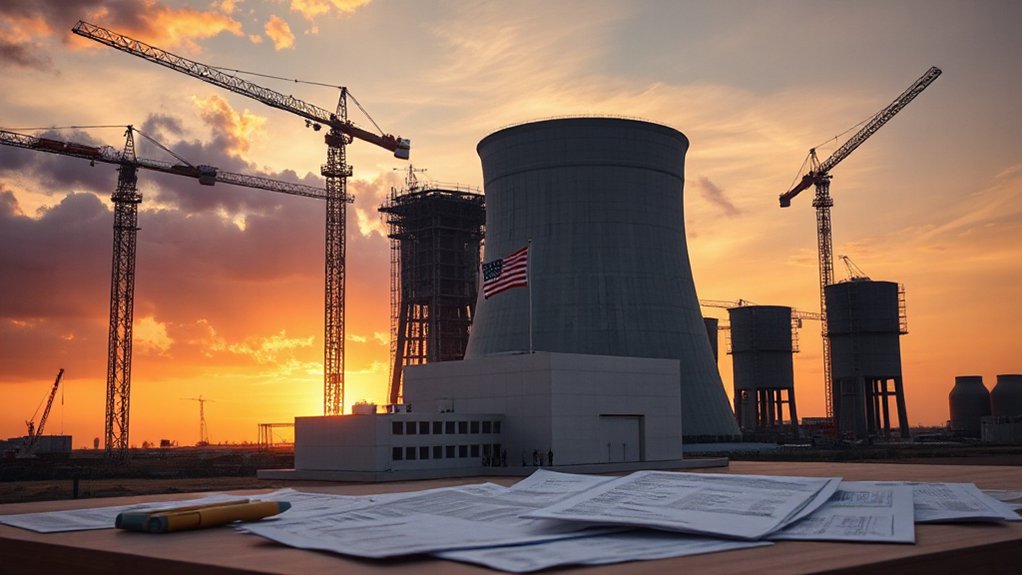

Three major pushes define America’s renewed nuclear ambitions: massive funding, regulatory overhauls, and aggressive export promotion. The feds aren’t playing around this time. With $2.7 billion in contracts for enriched uranium and a $1 billion loan to restart a Pennsylvania plant, Uncle Sam’s checkbook is wide open.
The money keeps flowing. Constellation Energy got a billion-dollar lifeline. Federal loan guarantees now cover up to 80% of advanced reactor costs. There’s even $11.5 million going to Amermin for recycling metals. Congress authorized $15.5 million through 2030 for international nuclear programs. The Department of Energy has offered up to $18.5 billion in loan guarantees specifically for advanced nuclear power plant construction. Not exactly chump change. This investment approach mirrors Seattle Port’s clean energy strategy that requested $500 million in federal funding to support its zero-emissions goals.
Federal dollars are supercharging nuclear’s comeback, with billions flowing to companies while loan guarantees cushion the financial risks.
Regulatory red tape? Consider it slashed. The May 2025 executive orders reformed NRC licensing processes. The 2019 Nuclear Energy Innovation and Modernization Act already limited inconsistencies. Price Anderson Act got extended 20 years. Nuclear companies just breathed a collective sigh of relief.
America’s nuclear export machine is revving up. The Nuclear Export Working Group, packed with federal officials, is pushing American atomic tech worldwide. They’re specifically targeting countries working with Russia and China. Section 8366 expands cooperation with these vulnerable nations. Subtle? Not remotely.
Meanwhile, we’re cutting ties with Russian uranium. The Prohibiting Russian Imports Act bans it, with waivers until 2028. Gotta wean off slowly, right?
The military wants in too. Section 318 created a DOD executive agent to figure out nuclear energy needs. They’re evaluating regulatory frameworks for military nuclear use. The FY 2026 NDAA mandates a 10-year pilot program for advanced nuclear reactors at Navy installations to provide constant mission-essential power. The Pentagon’s not waiting around.
Domestic infrastructure is getting a boost. The Versatile Test Reactor program promises fast-spectrum neutron irradiation by 2026. We’re expanding uranium conversion after a decade of neglect. About time.
Is this trillion-dollar resurrection affordable? America’s betting big that it is. Between executive orders recognizing nuclear as clean energy, federal risk insurance of $2 billion for regulatory delays, and waiving antitrust laws for international negotiations, the message is clear: America’s going atomic, and the meter’s running.
References
- https://www.morganlewis.com/blogs/upandatom/2025/12/national-defense-authorization-act-for-fy-2026-creates-holistic-strategy-to-support-us-nuclear-industry-leadership
- https://world-nuclear.org/information-library/country-profiles/countries-t-z/usa-nuclear-power-policy
- https://www.latitudemedia.com/news/the-department-of-energys-2026-playbook/
- https://docs.house.gov/meetings/IF/IF03/20260107/118801/HHRG-119-IF03-20260107-SD002.pdf
- https://www.heritage.org/energy/commentary/modern-us-nuclear-energy-policy
- https://www.theregreview.org/2026/01/03/seminar-why-u-s-nuclear-licensing-moves-so-slowly/
- https://www.ans.org/news/2026-01-06/article-7650/inn-asksi-why-are-states-racing-to-get-back-into-nuclear/
- https://www.nrc.gov/reading-rm/doc-collections/news/2026/index
- https://www.energy.gov/ne/office-nuclear-energy