Three competing interests are clashing over Nevada’s underground hot water. Regulators want oversight. Developers need efficiency. Environmentalists demand protection. It’s getting messy.
Nevada currently requires permits for geothermal water use under a “first-in-time, first-in-right” system. Sounds fair, right? But here’s where it gets weird. Reinjection triggers both state quality statutes and federal Underground Injection Control requirements. Talk about regulatory soup.
Take the Peppermill Hotel Casino in Reno. They operate under permit UNEV87064, injecting water from a 750-foot aquifer into well IW-9. Their water contains fluoride, sulfate, and arsenic exceeding drinking standards. Not exactly what you’d want in your morning coffee.
Now Assembly Bill 109 wants to shake things up. The bill clarifies that underground waters belong to the public, requiring appropriation for geothermal development. Industry folks are losing their minds. Why? The bill slaps new water-rights permitting on top of existing oversight. Double the paperwork, double the fun! Not.
Assembly Bill 109 transforms public water rights, triggering industry panic over regulatory redundancy. Bureaucratic overkill at its finest!
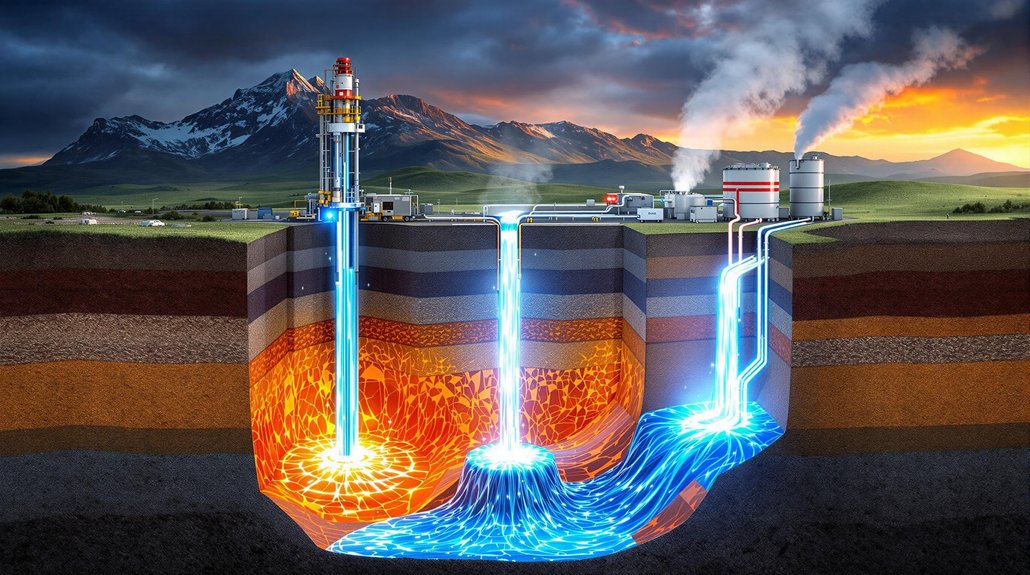
Geothermal Rising, an industry group, is pushing back hard. They argue current regulations already cover drilling, well integrity, and reinjection effectively. Most systems are closed-loop and non-consumptive anyway. Water goes in, water comes out. Simple physics.
The timing couldn’t be worse. The 2026 Geothermal Investors Forum is scheduled for April in Nevada. Nothing says “invest here” like regulatory uncertainty!
Critics recommend clearer definitions between potable water and geothermal brine. Makes sense. They also want recognition of reinjection-based systems and better agency coordination. Revolutionary concepts, apparently.
Nevada faces a choice: maintain its competitive edge in geothermal energy or create a permitting labyrinth that drives investment elsewhere. Meanwhile, the Peppermill keeps pumping hot water for space heating while monitoring injectate quality. This balancing act reflects the broader challenges developers face when acquiring water rights for geothermal projects across western states.
Despite the regulatory hurdles, geothermal energy has significant growth potential, with capacity to meet up to 15% of demand by 2050 if properly developed. Nevada and California currently dominate the market with 95% of capacity concentrated in these two western states.
The question remains: Can Nevada balance water protection with clean energy development? Or will bureaucracy boil this opportunity dry?
References
- https://openei.org/wiki/RAPID/Geothermal/Jurisdictions
- https://www.hollandhart.com/state-federal-incentives-heat-up-geothermal-projects
- https://ndep.nv.gov/uploads/documents/UNEV87064_factsheet_2025.pdf
- https://www.leg.state.nv.us/App/InterimCommittee/REL/Document/32072
- https://capstonedc.com/insights/how-geothermal-developers-will-benefit-from-updated-federal-policies/
- https://trackbill.com/bill/nevada-assembly-bill-109-revises-provisions-relating-to-water-bdr-48-212/2624057/