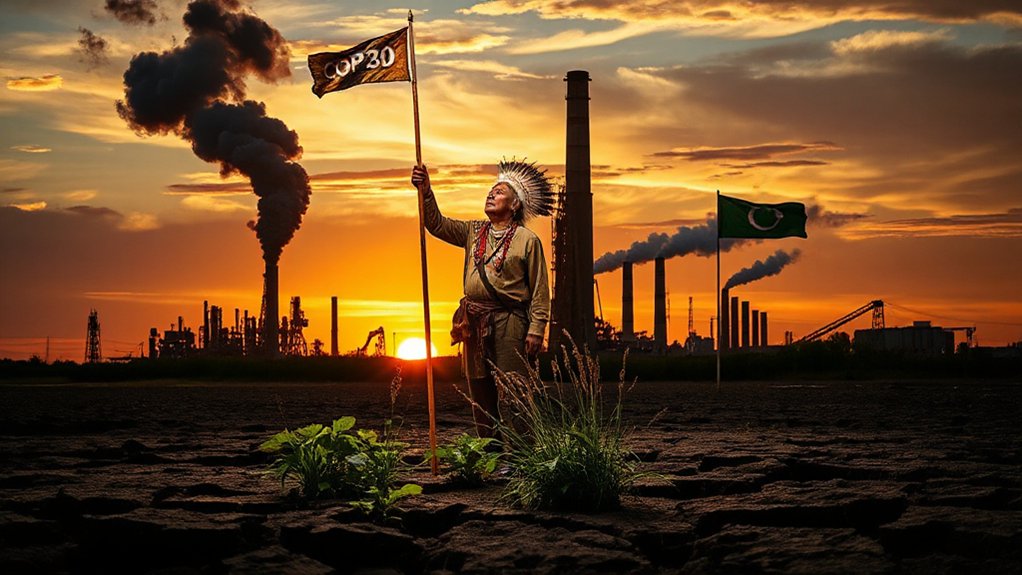

While Indigenous Peoples celebrated unprecedented recognition at COP30, with over 2,500 participants and the establishment of the groundbreaking Peoples’ Circle advisory body, the climate summit delivered a mixed bag of victories and disappointments. Three key documents explicitly acknowledged Indigenous rights, including the Global Mutirão, mitigation work program, and just conversion mechanism. Not bad for a conference that historically sidelined native voices.
The Intergovernmental Land Tenure Commitment emerged as a highlight, with fifteen governments pledging to formally recognize 160 million hectares of Indigenous-held lands. Add to that a renewed Forest and Land Tenure pledge worth $1.8 billion through 2030, now expanded beyond forests to include savannas and mangroves. Brazil and Indonesia stepped up with promises of new territorial protections. These initiatives could help combat rapid deforestation that significantly contributes to greenhouse gas emissions. The significant attention to nature-based solutions reflected a growing emphasis on Indigenous-led climate resilience approaches.
But while Indigenous rights gained ground, fossil fuels slipped through the cracks. Again. The final text completely omitted explicit language on phasing out fossil fuels, despite more than 80 countries backing Brazil’s proposal for a formal phase-out roadmap. Another 80 countries opposed it. Guess which side won? COP30 instead introduced a roadmap for a just transition away from fossil fuels without committing to their elimination.
The final decision merely refers to the UAE Consensus from COP28 about “shifting away” from fossil fuels—whatever that means. Scientists like Carlos Nobre weren’t mincing words, warning that fossil fuel use must hit zero by 2040-2045 to avoid catastrophic warming of up to 2.5°C. Without action, say goodbye to coral reefs and the Amazon rainforest.
Brazil, frustrated by the diplomatic deadlock, announced its own initiative to develop a roadmap for a fossil fuel-free economy. Too little, too late? Maybe. At least they’re trying something.
The new “just conversion” mechanism aims to guarantee an equitable shift to clean energy, with special protections for Indigenous Peoples in voluntary isolation. But without concrete fossil fuel phase-out plans, it’s like building a lifeboat without planning to abandon the sinking ship.
Indigenous rights secured a win, while the planet took another loss.
References
- https://www.wri.org/insights/cop30-outcomes-next-steps
- https://news.un.org/en/story/2025/11/1166433
- https://cop30.br/en/news-about-cop30/cop30-landmark-outcomes-emerge-from-negotiations-despite-unprecedented-geopolitical-tensions
- https://www.nature.com/articles/d41586-025-03802-1
- https://globalwitness.org/en/campaigns/fossil-fuels/cop30-verdict-people-in-polluters-still-in/
- https://climatenetwork.org/2025/11/22/cop30-takes-a-hopeful-step-towards-justice-but-does-not-go-far-enough/