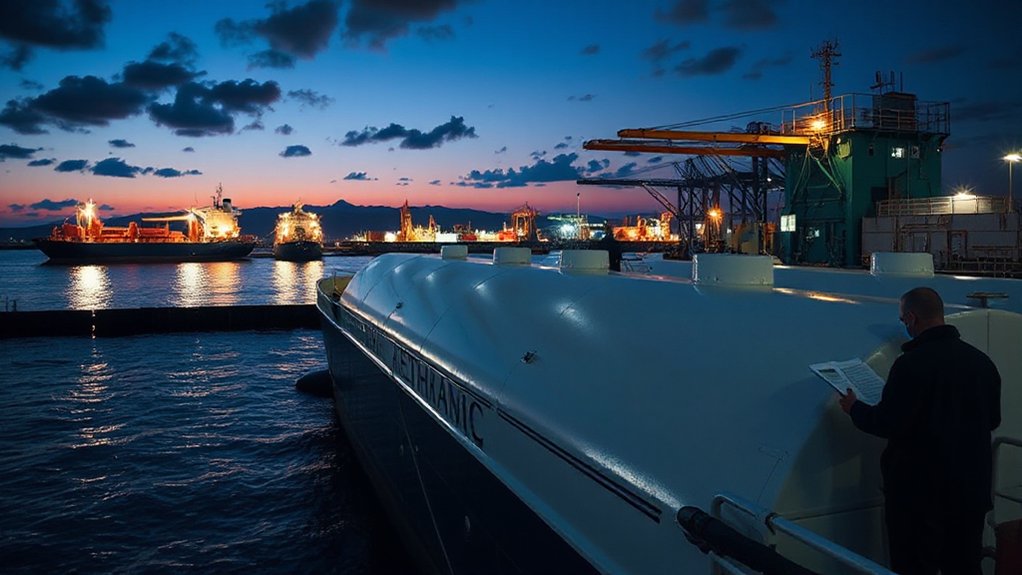
Nearly every major shipping company is scrambling to meet ambitious carbon reduction targets as the maritime industry faces its biggest fuel revolution since coal gave way to oil. The International Maritime Organization isn’t messing around – they’ve laid down the law: 40% emissions reduction by 2030, ramping up to 70% by 2050. Tough luck, shipping execs.
The methanol movement is gaining serious momentum. Over 450 methanol-capable vessels are already in operation or on order globally. Big players like Maersk and Stena aren’t just dipping their toes in the water – they’re diving headfirst into methanol adoption. Maersk alone signed a deal with Orsted for 300,000 tons of e-methanol yearly for their shiny new fleet of 12 methanol-powered vessels. Talk about commitment.
Shipping giants aren’t playing small – they’re betting big on methanol as the future of maritime fuel.
But here’s the kicker – the price tag. Bio-methanol costs around USD 2,500 per tonne in 2025, roughly triple what you’d pay for marine gas oil. Not exactly pocket change. Green methanol? Even worse. It’s expensive and about as scalable as a pet rock business. The economics just don’t add up yet.
Infrastructure is slowly catching up. Singapore, the world’s largest bunkering hub, is now accepting applications for methanol supply licenses. But global production sits at a measly 2.2 million tonnes – a drop in the ocean compared to the potential 60 million tonnes needed by 2040. Someone’s got some catching up to do. The cleaner combustion of methanol significantly reduces NOx, SOx, and particulates compared to traditional fuels. Europe is currently leading the market with substantial investments in both green hydrogen and carbon capture technologies needed for e-methanol production.
The FuelEU Maritime regulation isn’t helping the stress levels either, demanding gradual emissions reductions starting next year. By 2030, at least 5-10% of maritime energy must come from zero or near-zero emission fuels.
The good news? The tech is solid. Methanol-fueled engines are ready to roll for all major ship types, with advanced systems delivering over 60% energy reduction. The revolution is primed for launch. Now if only someone could fix those pesky cost problems.
References
- https://www.resourcewise.com/blog/methanols-emerging-role-in-the-bunkering-market
- https://www.globenewswire.com/news-release/2025/05/21/3085577/28124/en/Green-Methanol-Industry-Research-Report-2025-2034-Maritime-Industry-Fuels-Surge-in-Demand-Policy-Support-Decarbonization-Efforts-Drive-Momentum-Governments-Pushing-Adoption.html
- https://www.dnv.com/news/2025/dnv-report-methanol-as-marine-fuel-at-high-readiness-level-but-adoption-hurdles-remain/
- https://advancedbiofuelsusa.info/advancing-maritime-decarbonization-the-2025-imo-agreement-and-the-fuel-transition
- https://britanniapandi.com/2025/05/alternative-fuels-update-april-2025/
- https://ammoniaenergy.org/articles/global-maritime-forum-alternative-fuels-rapidly-progressing-to-commercial-deployment/
- https://www.thedecarbhub.org/insights-and-resources/the-future-of-maritime-fuels/
- https://www.dlr.de/en/ms/latest/news/new-study-published-green-methanol-as-an-alternative-marine-fuel