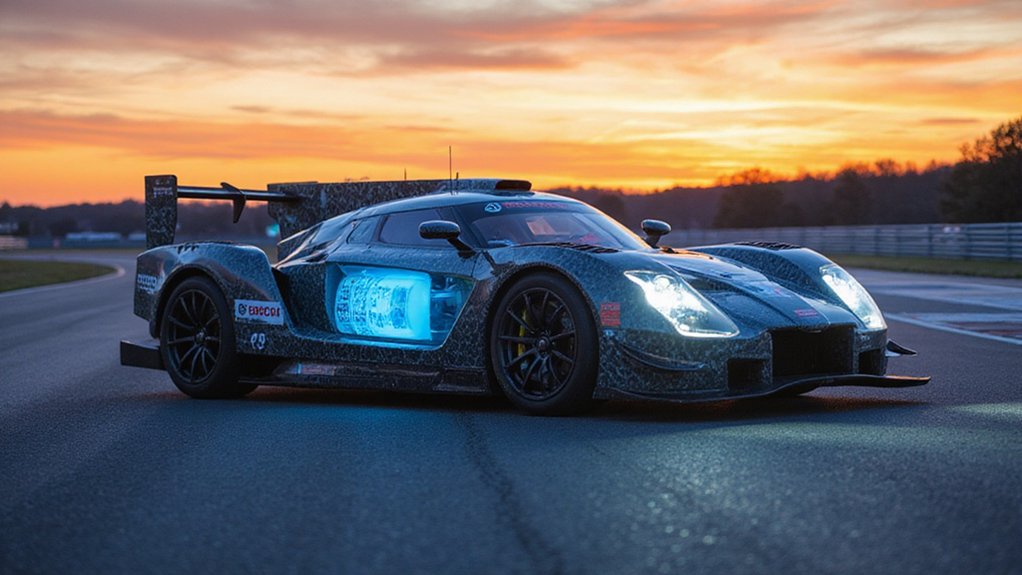

As the racing world continues its shift toward greener technologies, Bosch Motorsport has revealed an innovative liquid hydrogen storage system set to debut at the 2025 Le Mans 24 Hours. The L-HSCU (Liquid Hydrogen Storage Control Unit) represents a major advancement in sustainable racing technology.
This system manages hydrogen cooled to an extreme -253°C, allowing it to be stored in liquid form. The ultra-cold temperature creates higher density fuel that requires considerably less space in the race car compared to gas storage methods. This space efficiency is essential for racing applications where every centimeter matters.
Bosch’s technology monitors and controls the entire hydrogen journey from refueling to engine delivery. Special sensors constantly check pressure and temperature throughout the fuel system. If anything unusual happens, automatic safety circuits immediately activate to protect the vehicle and driver.
Safety drives innovation as sensors and circuits monitor every molecule of hydrogen, ready to protect at a millisecond’s notice.
The L-HSCU works with pressures up to 5 bar in the tank and can support both 350 bar and 700 bar systems, making it adaptable worldwide. The technology will first be showcased in the H24EVO demo vehicle from the MissionH24 program. It includes fans that automatically turn on if sensors detect a hydrogen leak, quickly diluting any gas concentration to safe levels.
Performance capabilities remain impressive despite the focus on safety. The system supports hydrogen engines producing up to 443 kW of power and 650 Nm of torque. It can handle mass flow rates of 60 g/s during filling and meets the demands of long-distance races exceeding 5,000 kilometers. While hydrogen faces storage challenges, advances like the L-HSCU are helping overcome significant limitations in renewable energy applications.
This technology didn’t develop in isolation. Bosch Engineering partnered with Ligier Automotive to create the Ligier JS2 RH2 demonstration vehicle. The vehicle demonstrated remarkable performance during testing under extreme temperature conditions ranging from freezing to sweltering heat. Bosch handled overall vehicle design plus vital engine and tank systems.
Beyond racing, the L-HSCU represents a scalable solution for hydrogen vehicles across all segments. As motorsport increasingly addresses climate concerns, Bosch’s liquid hydrogen system stands as a milestone in racing’s evolution toward sustainability, proving that high performance and environmental responsibility can successfully coexist.
References
- https://www.automotivepowertraintechnologyinternational.com/news/sustainable-fuels/bosch-to-introduce-h2-concept-at-le-mans-24-hours.html
- https://www.bosch-presse.de/pressportal/de/en/le-mans-24h-innovation-vehicle-of-bosch-engineering-and-ligier-automotive-with-hydrogen-engine-shows-the-sustainable-future-of-motorsport-265408.html
- https://www.greencarcongress.com/2025/05/20250516-bosch.html
- https://www.bosch-mobility.com/en/solutions/powertrain/fuel-cell-electric/hydrogen-storage-system
- https://www.bosch-motorsport.com/passion/stories/le-mans-story-technology-highlights-from-bosch/