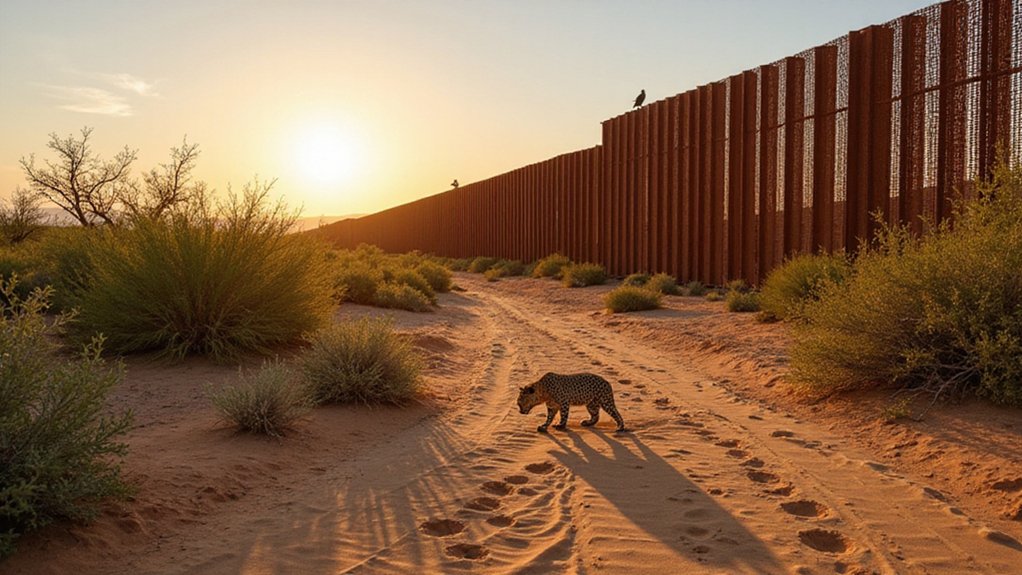

Concrete and steel now cut across one of North America’s most biodiverse regions. The border wall divides natural habitats and isolates wildlife populations that once roamed freely between countries. Recent studies show the devastating impact on animal movement, with only 9% of wildlife interactions with the wall resulting in successful crossings.
The barrier affects 1,506 native species of animals and plants. Large mammals like black bears, mountain lions, and deer can’t cross at all. Jaguars, ocelots, and Mexican gray wolves—already endangered—face greater threats as their territories are sliced in half. Even wild turkeys can’t get through.
Scientists found just 13 small wildlife passages along more than 130 kilometers of continuous wall. Camera traps reveal an 86% reduction in wildlife crossings compared to areas with only vehicle barriers. The few openings that exist are too small for many animals, completely blocking migration routes needed for food, water, and mating.
The wall’s impact extends beyond individual species. When animals can’t move freely, they can’t fulfill their ecosystem roles. Seed dispersal, pest control, and predator-prey relationships all suffer. Without top predators like jaguars crossing the border, prey populations may grow unchecked, throwing ecosystems out of balance. The wall’s construction has contributed to genetic isolation for species like the ferruginous pygmy owl and desert bighorn sheep due to disrupted gene flow.
Small and medium-sized animals like collared peccaries, coyotes, and American badgers occasionally use the rare passages. But even for these animals, options are limited. Researchers found these small wildlife passages facilitate 16.7 times more crossings for these smaller species than areas without passages. Researchers note decreased animal presence near walls using both camera evidence and environmental DNA studies.
The consequences reach far beyond wildlife. Ecosystem services that benefit humans decline as species diversity drops. The wall makes it harder for animals to adapt to climate change by limiting their ability to shift territories as conditions change.
Conservation experts say more and larger wildlife passages are urgently needed. Without them, the rich biodiversity of this unique region faces long-term decline, with species potentially vanishing from areas where they once thrived.
References
- https://www.wildlandsnetwork.org/news/new-study-reveals-an-86-reduction-in-wildlife-crossings-at-the-border-wall-our-experts-explain-why
- https://knowablemagazine.org/content/article/food-environment/2024/the-impact-of-the-us-mexico-border-wall-on-biodiversity
- https://www.frontiersin.org/journals/ecology-and-evolution/articles/10.3389/fevo.2024.1487911/full
- https://www.audubon.org/features/esri-embattled-borderlands
- https://www.wildlandsnetwork.org/newsroom/us-mexico-border-wall-severely-impacts-movements-of-large-wildlife-reducing-successful-wildlife-crossings-by-86nbsp