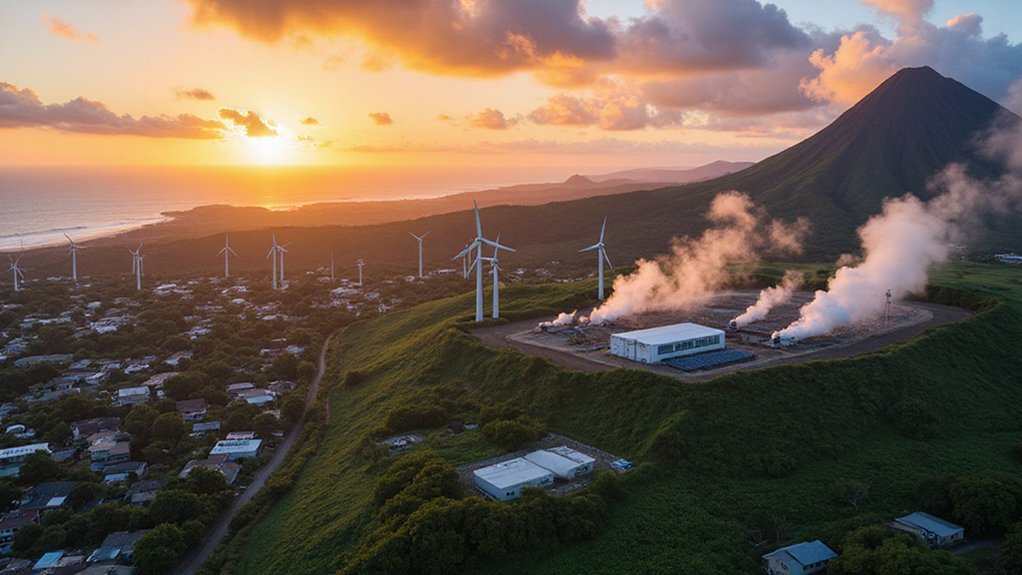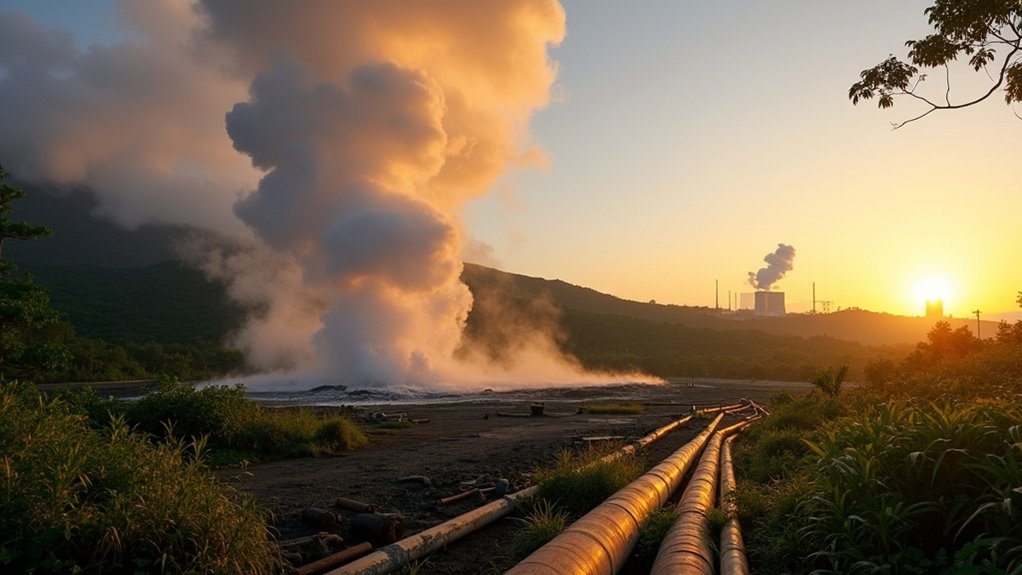

Indonesia sits on a goldmine. Not the shiny metal kind—the steaming, bubbling, volcanic kind that could power millions of homes. With 40% of the world’s geothermal potential, roughly 28,000 MW worth, the archipelago nation is basically sitting on Earth’s biggest natural battery. Yet here’s the kicker: they’re only using about 2,356 MW of it.
Indonesia owns Earth’s biggest natural battery but barely uses it—a volcanic goldmine gathering dust.
That’s like owning a Ferrari and driving it in first gear. Forever.
The numbers are staggering. Indonesia has identified 357 geothermal locations scattered across its islands, from Sumatra to Papua. Java alone packs 1,820 MW of proven reserves, while Sumatra holds another 1,070 MW. Even tiny Maluku and Papua have their share. The total potential? A whopping 29,544 MW—nearly half of Indonesia’s entire electricity generation capacity. The country’s 16 operating geothermal plants range from tiny 2.5 MW facilities to the massive Salak plant in West Java, which at 377 MW capacity ranks as the world’s fourth-largest geothermal installation.
So what’s the holdup? Indonesia ranks second globally in geothermal usage, trailing only the United States. Not bad, right? Wrong. When your geothermal contribution is less than 3% of total electricity generation despite having the world’s largest reserves, something’s off. Way off. The country’s energy mix tells the real story: fossil fuels dominate up to 85% while renewables barely scrape together 13-15%.
The government keeps setting ambitious targets. They wanted 4,000 MW by 2014. Didn’t happen. Then 7,241.5 MW by 2025. With current growth rates, good luck with that. Now they’re eyeing 9.3 GW by 2030. At this pace, they’ll need a time machine.
Back in 2010, officials announced 44 new plants. Big promises, small delivery. The Asian Development Bank and World Bank weren’t impressed either, basically saying Indonesia needs major policy reforms to get this volcanic party started.
Here’s what’s planned: 168 high-temperature projects totaling 6,896.5 MW, plus 52 medium-temperature ones adding 1,157 MW. Sounds impressive until you realize 126 projects don’t even have clear timelines.
The irony burns hotter than the geothermal wells themselves. Indonesia could theoretically become the world’s top geothermal producer, surpassing the US entirely. Instead, growth crawls along while coal plants keep churning. The volcanic wealth remains mostly underground, waiting. And waiting. While a nation that desperately needs clean energy sits on the solution. Despite high initial investments, geothermal energy offers stable pricing and minimal maintenance costs over facilities that can operate reliably for 20-50 years.
References
- https://www.thinkgeoenergy.com/wp-content/uploads/2021/05/Indonesia-short.pdf
- https://energytracker.asia/geothermal-energy-indonesia/
- https://new.abb.com/news/detail/126257/harnessing-geothermal-energy-to-power-indonesias-renewable-future
- https://en.wikipedia.org/wiki/Geothermal_power_in_Indonesia
- https://eavor.com/blog/geothermal-and-indonesias-energy-transition/