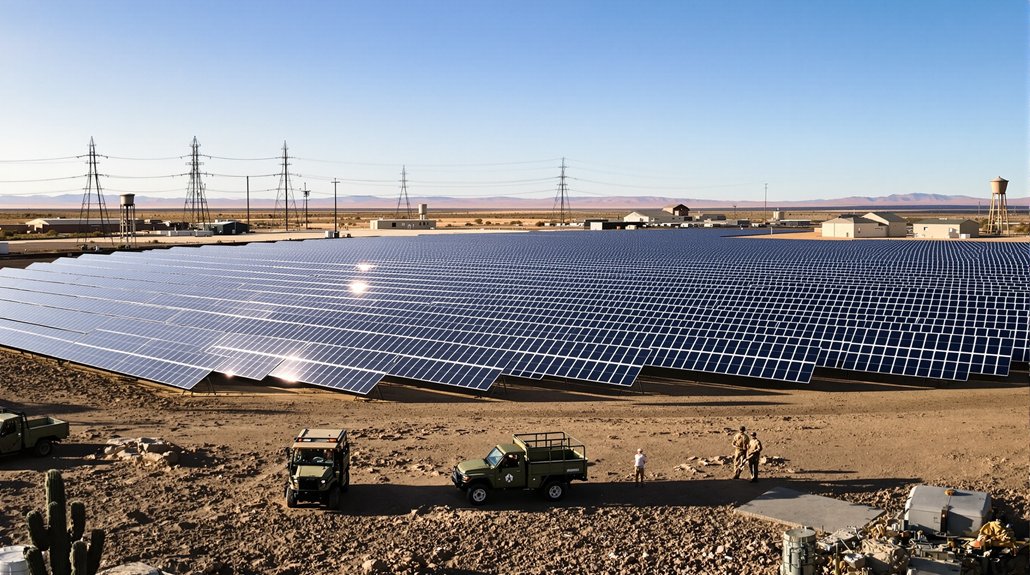

While the U.S. military has long been known for its firepower, it’s now flexing a different kind of muscle—solar power. The Army’s getting serious about going green, with a 13 MW solar project recently completed at Fort Polk that’s set to boost energy resilience. Not just fancy environmental talk—this is about survival when the grid goes down.
Fort Bragg’s already reaping the benefits. Their 1.1 MW solar setup saves a cool $100,000 every year. Money that can go toward, you know, actual military stuff. The bean counters must be thrilled.
The Department of Defense burns through more electricity than 2.6 million American homes. Let that sink in. Fort Hood’s solar and wind project is cutting carbon emissions by 132,000 tons annually—like taking 23,000 cars off the road. Not bad for an institution designed to blow things up.
These solar arrays aren’t just for show. They’re keeping the lights on at critical facilities during storms and outages. Even forward operating bases are getting equipped with solar-powered water purification and drone charging stations. The future of warfare runs on sunshine, apparently.
The military isn’t stopping there. They’re opening up 16 million acres of land for renewable development, with 13 million in the sunny U.S. West. Talk about prime real estate.
It hasn’t all been smooth sailing. The Army Corps of Engineers hit the pause button on 168 renewable project permits in 2025. Bureaucracy—the one enemy even the military struggles to defeat.
Public-private partnerships are making this solar transformation possible without breaking the government bank. Private companies handle the upfront costs while the military gets the energy security benefits. Win-win.
The joint venture between Onyx Renewables and Corvias will help Fort Polk meet 42% of electricity demand for on-base housing in its first year of operation.
The green machine is rolling forward. Solar power is becoming as essential to national security as tanks and planes. Much like South Africa’s experience, the military is seeing that renewable energy is not just environmentally sound but also makes cost-effective sense as prices continue to drop. The Army’s commitment to cut emissions by 50% by 2032 underscores the seriousness of their energy transition strategy. Who would’ve thought the Army would lead America’s energy transformation? Turns out the future isn’t just green—it’s camouflage green.
References
- https://www.onyxrenewables.com/insights/onyx-renewables-completes-construction-of-13-mw-solar-project-at-fort-polk-military-installation
- https://8msolar.com/how-solar-power-is-redefining-military-operations/
- https://seia.org/news/us-militarys-big-plan-renewable-energy-projects/
- https://pv-magazine-usa.com/2025/02/06/federal-pause-to-solar-permitting-and-wetland-approvals/
- https://www.onyxrenewables.com/case-studies/strengthening-energy-resilience-for-the-u-s-army-with-13-mw-solar-project