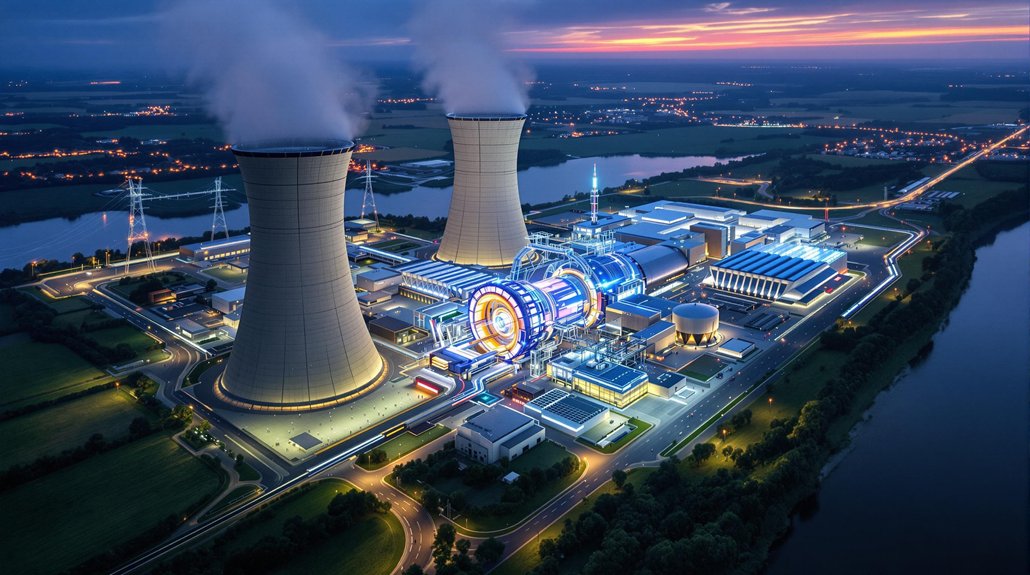

Germany plans to build a 1-gigawatt fusion power plant at the former Biblis nuclear site by 2035. The €5-7 billion project involves Focused Energy, RWE, and the state of Hesse. It’ll use advanced inertial fusion technology with solid-state lasers. The plant aims to achieve net-positive fusion power for the first time in history. This bold initiative marks Germany’s return to nuclear technology and positions it as a serious contender in the global fusion race.
Nearly a decade after shutting down all nuclear power plants, Germany is making a surprise comeback in the atomic energy field. The country has disclosed ambitious plans to build a 1-gigawatt fusion power plant at the site of its former Biblis nuclear facility. This bold move represents Germany’s attempt to lead in clean energy production while competing with global fusion efforts.
Focused Energy, RWE, and the state of Hesse signed a memorandum of understanding to develop the massive fusion project. They aim to complete it by 2035 at a cost of €5-7 billion. The initiative marks Germany’s return to nuclear technology, but with a focus on fusion rather than traditional fission power.
The project will use inertial fusion technology with solid-state lasers. Focused Energy’s method employs a direct-drive approach where lasers and proton beams target small spheres filled with deuterium and tritium fuel. The company claims its technology is 30 times more efficient than earlier laser systems. This innovative approach could lead to net-positive fusion power for the first time in history.
Germany’s new conservative government, elected in February 2025, strongly supports fusion development. Hesse has pledged €20 million in initial research funding, while RWE provides land, expertise, and project management. The proposed plant would be the first laser-based fusion facility operating at grid scale in the world. A nuclear fusion industry consortium has also formed in Hesse to support the initiative.
The German effort enters a competitive global landscape. The UK has committed £410 million to fusion research, France has advanced plasma confinement, and the US leads in private investment. China is also making strides in plasma technology.
Technical challenges remain, including precision targeting, repetition rate issues, and tritium supply concerns. Regulatory frameworks for fusion technology are still under development.
If successful, the Biblis fusion plant could transform Germany’s energy landscape. It promises nearly limitless clean energy production, new high-tech jobs, and increased energy security. The project might also inspire other nations to invest in fusion technology as a solution to climate change and energy needs.