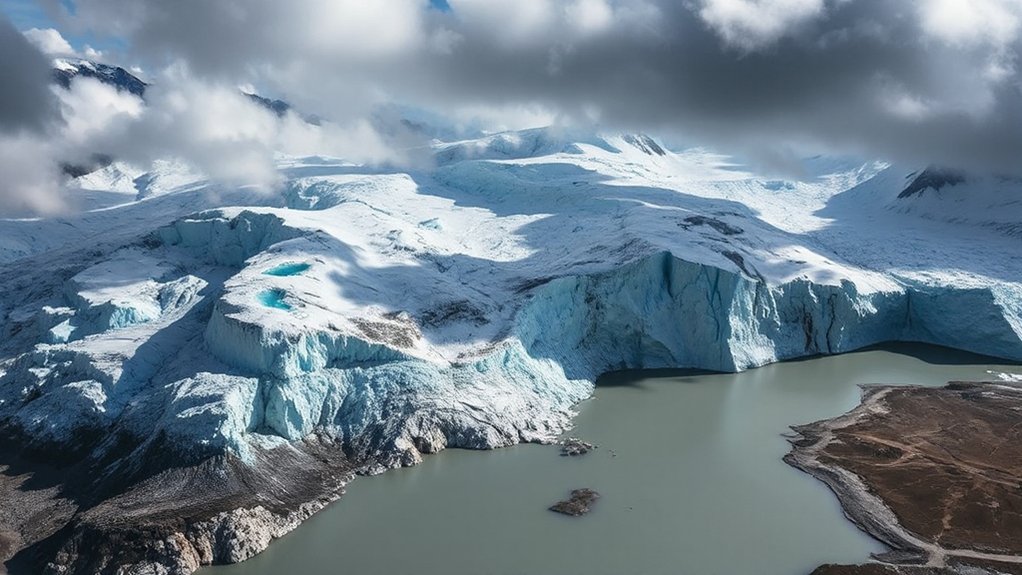
While politicians haggle over climate targets, Earth’s glaciers aren’t waiting around for consensus. They’re melting at a staggering rate—273 billion tonnes annually—with recent years breaking all the wrong records. The last five years? Worst glacier loss ever recorded. In 2024 alone, 450 billion tons of ice vanished. Going, going, gone.
As politicians debate, glaciers dissolve—273 billion tonnes yearly—breaking records while Earth’s ice quietly vanishes.
The numbers tell a brutal story. Since 2000, we’ve lost 6,542 billion tons of ice worldwide. That’s not a typo. Five percent of all remaining glacier mass disappeared in just 23 years, and 41% of all losses since 1976 happened in the last decade. Talk about acceleration.
Regional patterns look equally grim. Alaskan glaciers have thinned by 125 vertical feet since mid-century. Arctic Scandinavia and Svalbard just recorded their largest annual ice loss. Central European glaciers? Down 39% in volume in two decades. Greenland’s peripheral glaciers lose 35 billion tonnes yearly. This trend aligns with the broader Arctic pattern, where the last decade marked the warmest 10 years on record. Not exactly winning.
The sea level implications are sobering. Last year’s glacier melt alone raised global sea levels by 1.5 millimeters. Every 0.1°C of additional warming drives 2% more ice loss. The math isn’t complicated. A comprehensive study involving 21 scientists from ten countries confirms these alarming trends. These environmental changes significantly contribute to the health consequences faced by millions globally, similar to how air pollution caused 8.1 million deaths in 2021.
Looking ahead, the picture gets apocalyptic. Even if we stabilize at today’s 1.2°C of warming, we lose 39% of all glacier mass. At 2.7°C? Three-quarters gone. And at 4°C warming—entirely possible given current policies—we’ll reach peak glacier extinction around 2055, with up to 4,000 glaciers disappearing annually.
The Alps will hit peak disappearance between 2033-2041. The Rockies will lose 99% of glaciers at 4°C warming. Central Asian glaciers? Ninety-six percent gone.
Beyond the numbers are real impacts: destroyed villages from ice collapses, threatened water supplies, increased flooding, and landslides. The choices made today determine not just this century’s glacier fate but Earth’s ice reserves for centuries to come. Meanwhile, the melt continues—no consensus required.
References
- https://arctic.noaa.gov/report-card/report-card-2025/
- https://www.marum.de/en/Glacier-Loss.html
- https://ethz.ch/en/news-and-events/eth-news/news/2025/12/the-alps-to-lose-record-number-of-glaciers-in-the-next-decade.html
- https://www.weforum.org/stories/2025/06/glacial-melting-nature-climate-news/
- https://www.dlr.de/en/latest/news/2025/glacial-melting-increases-freshwater-loss-and-accelerates-sea-level-rise
- https://wmo.int/news/media-centre/glacier-melt-will-unleash-avalanche-of-cascading-impacts
- https://www.climate.gov/news-features/understanding-climate/climate-change-mountain-glaciers
- https://news.rice.edu/news/2025/rice-anthropologists-spotlight-human-toll-glacier-loss