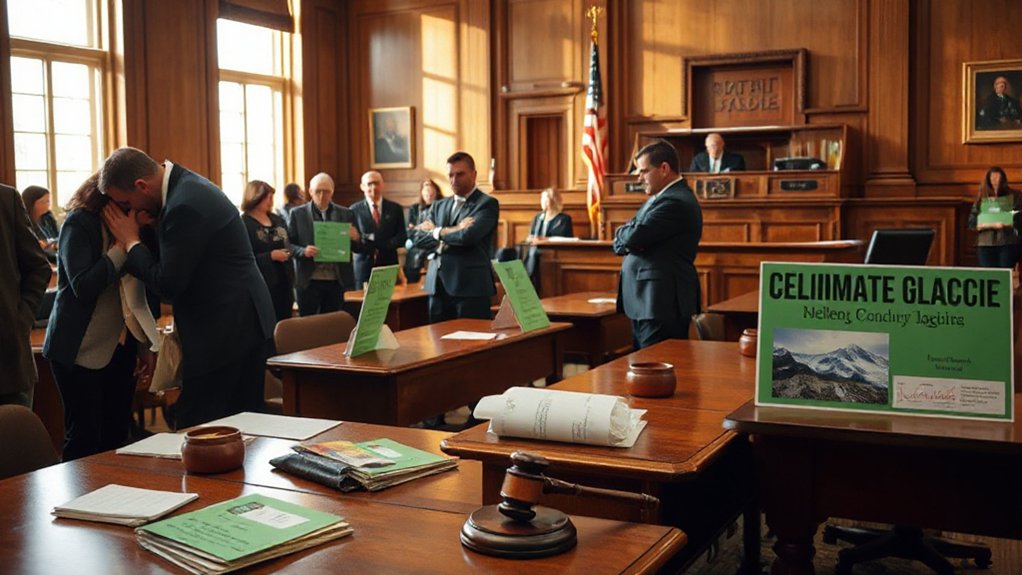

How did the scales of justice finally tip toward climate accountability? 2025 marked a seismic shift in the legal landscape, with courts across America—and beyond—rejecting Big Oil’s tired excuses. Federal judges blocked a massive 73-million-acre offshore oil lease sale in the Gulf of Mexico, citing climate impacts and risks to endangered species like Rice’s whale.
Turns out destroying the planet isn’t just bad PR—it’s legally actionable.
Corporations beware: climate destruction has moved from PR problem to courtroom liability.
Colorado landowners scored a win when a federal court certified their class action against oil and gas companies for abandoning wells. Methane leaks? Measurable harm. The courts said so. Nearly 30 times in 2025, federal courts shut down Big Oil’s procedural gymnastics to escape accountability.
Every single state supreme court that addressed climate deception cases allowed them to proceed. Maine’s case boomeranged back to state court after removal attempts crashed and burned. Judges across jurisdictions fundamentally said, “Nice try, but no.”
The judicial branch wasn’t having it when hundreds of millions in environmental funds mysteriously froze either. A Seattle judge blocked the cancellation of $9 million earmarked for Washington State’s climate resilience projects. The Tribal Stewards program got its money back too.
One judge noted that allowing administrations to mess with multi-year grants would create “unnecessary chaos.” No kidding.
When the $7 billion Solar for All program faced abrupt termination, 23 states sued. Courts stepped in to address the clean energy funding freeze, establishing precedent for challenging arbitrary program cancellations.
Internationally, the landscape shifted too. The International Court of Justice unanimously confirmed climate change as an “urgent and existential threat” in July 2025. Human rights, including the right to life, are at stake.
Not just flowery language—binding international law.
Even corporations felt the heat when a Dutch Court of Appeal ruled Shell legally obligated to cut emissions. This ruling joined a growing body of over 70 climate cases worldwide that have been inspired by the groundbreaking Urgenda case. The message is clear: The days of consequence-free climate destruction are over. Finally.
A landmark jury verdict in Louisiana ordered Chevron to pay $744.6 million for wetland restoration, setting a precedent for how corporations must financially account for environmental damages. The verdict punished Chevron for coastal wetland damage caused by decades of dredging canals and dumping wastewater into fragile marshes.
References
- https://blog.ucs.org/delta-merner/the-courts-delivered-important-climate-wins-in-2025/
- https://www.urgenda.nl/en/themas/climate-case/global-climate-litigation/
- https://www.lse.ac.uk/granthaminstitute/publication/global-trends-in-climate-change-litigation-2025-snapshot/
- https://careclimatechange.org/world-courts-landmark-climate-opinion-demands-bold-action-from-governments/
- https://climatelitigationnetwork.org
- https://sdg.iisd.org/commentary/guest-articles/icjs-landmark-ruling-and-the-future-of-health-based-climate-litigation/
- https://www.climatecasechart.com
- https://www.nortonrosefulbright.com/en/knowledge/publications/674162d1/climate-change-litigation-update-july-2025