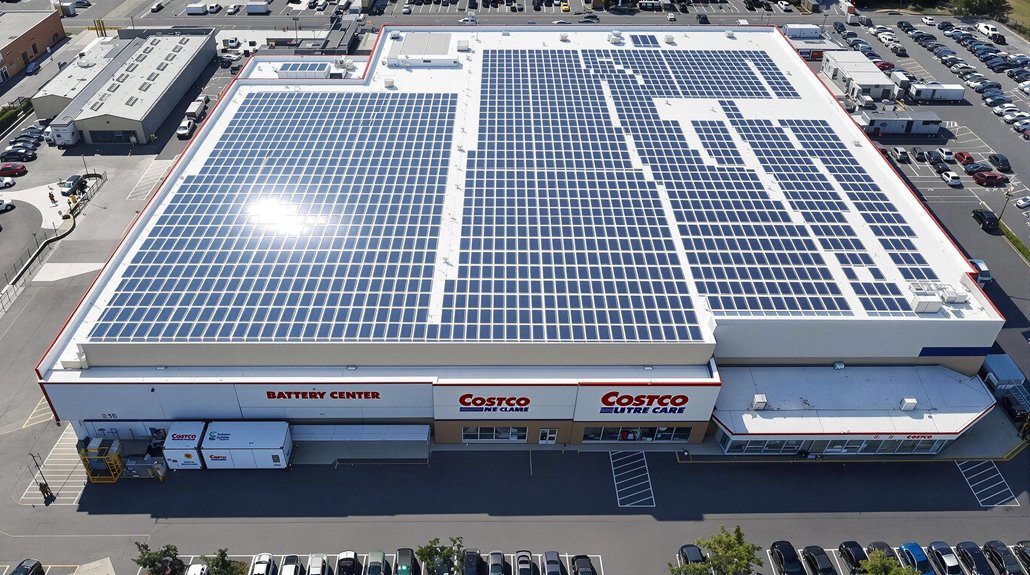

While many retailers struggle with rising energy costs, Costco has taken a bold step toward energy independence at its Norwalk, Connecticut location. The wholesale retail giant has installed a modular solar and battery microgrid system that delivers up to 2 megawatt-hours (MWh) of electricity per day, powering the store’s standalone tire center completely off-grid.
This innovative system was designed and installed by Trinity Energy, a company that specializes in turnkey sustainable energy solutions. The microgrid combines solar panels and battery storage with smart energy management to optimize local electricity use. It’s built to operate fully independent from the main power grid.
The Norwalk microgrid represents a shift in how Costco views energy – not just as an operating cost, but as a strategic business asset. By generating its own clean power, the company reduces its dependency on the grid and protects itself from blackouts and utility rate increases. This approach helps Costco achieve greater operational continuity in an era of increasing grid instability. The project exemplifies the broader trend where clean energy jobs are growing at twice the rate of the overall economy.
Energy transformed from cost center to strategic advantage—powering Costco’s future while building resilience against market volatility.
The system’s daily 2 MWh output translates to approximately 730 MWh of clean energy annually. This directly cuts carbon emissions by replacing grid electricity with renewable energy. The project aligns with Costco’s broader sustainability goals, which include developing over 100 on-site solar facilities and sourcing 80% clean energy by 2030. The company has already seen a 5% reduction in carbon intensity across its operations in fiscal 2022.
Costco has also completed a similar microgrid project at its Mira Loma distribution center in California. That system generates about 100 MWh per year to charge electric trucks, supporting the company’s plan to convert depot yard trucks to alternative fuels by 2035.
The Connecticut microgrid serves as a real-world demonstration for comparable installations in other commercial settings. Its modular design allows for quick deployment and easy scaling. If successful, this approach could be expanded to other Costco locations.
References
- https://www.nacleanenergy.com/solar/trinity-and-costco-launch-scalable-off-grid-power-solutions-with-innovative-energy-system
- https://www.microgridknowledge.com/commercial-industrial-microgrids/article/33017341/costco-warehouse-using-off-grid-to-solar-to-power-fleet-electrification
- https://www.solarpowerworldonline.com/2025/08/costco-warehouse-in-connecticut-adds-on-site-solar-storage-system/
- https://ground.news/article/costco-and-trinity-launch-scalable-off-grid-power-solutions-with-innovative-energy-system-cleantechnica
- https://www.microgridknowledge.com