While the rest of the world debates old-school energy options, California is betting big on fusion power—the holy grail of clean energy that’s always been “just around the corner.” The Golden State now hosts 16 core nuclear fusion companies and has attracted a whopping $2.2 billion in funding for fusion ventures.
This isn’t just another California tech bubble. Experts project the fusion energy industry could explode to somewhere between $48 billion and $125 billion. Not bad for technology that hasn’t actually delivered a single watt to the grid yet.
California’s not just throwing money at a sci-fi dream. The state government formalized its support with SCR 25 legislation, officially backing fusion research and development. They’re planning for a fusion pilot plant in the 2030s or 2040s. Yeah, still decades away. Shocking.
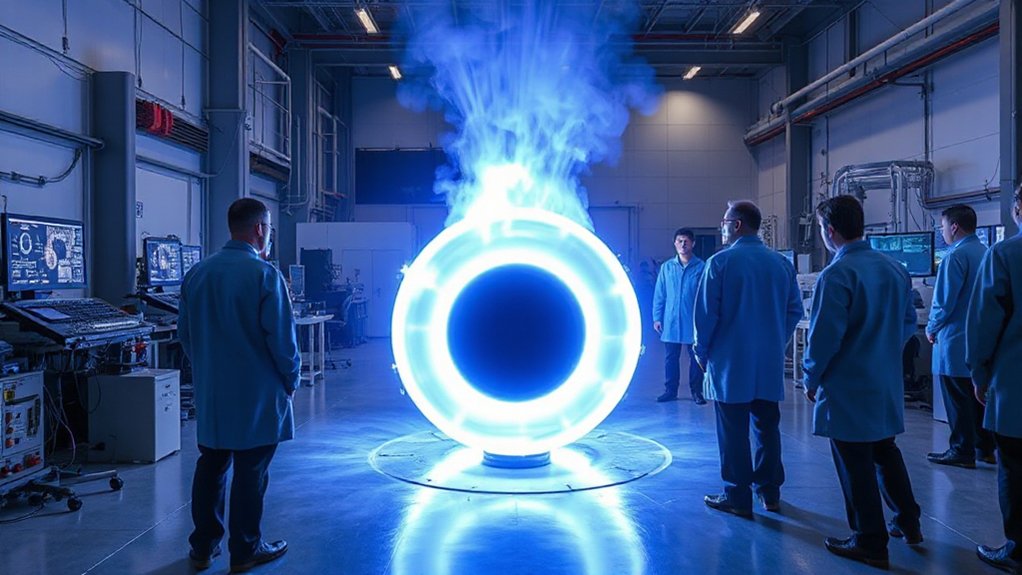
The science is getting real, though. At San Diego’s DIII-D National Fusion Facility, researchers are working with one of North America’s largest tokamaks – fundamentally a magnetic bottle for containing superhot plasma. Much like Japan’s approach with its Basic Hydrogen Strategy, California is positioning itself to lead in next-generation energy technology.
Meanwhile, General Atomics finished building the world’s largest pulsed superconducting magnet in San Diego. It’s heading to ITER in France, the international fusion project that’s been under construction since forever.
Private companies aren’t waiting for the government’s timeline. They’re aiming for smaller, more efficient pilot plants to demonstrate fusion power sooner. Their goal? Fusion ignition – when the reaction becomes self-sustaining. Basically, creating a tiny star in a lab.
What’s the payoff? Virtually limitless, carbon-free energy without nasty nuclear waste. Perfect for California’s ambitious climate goals. Plus, it could power our insatiable appetite for AI and other energy-hungry tech.
Challenges remain. Regulatory uncertainty looms large. California’s notoriously high land costs don’t help either. But with universities, national labs, and private industry working together, the fusion ecosystem is growing. The University of California’s Office of the President has been instrumental in establishing the Pacific CREST Fusion initiative to advance research collaboration. The state faces significant grid interconnection delays that must be addressed to successfully bring fusion energy online.
California isn’t just dreaming about fusion anymore. It’s building it. The revolution might actually happen this time.
References
- https://autl.assembly.ca.gov/system/files/2025-06/scr_25-blakespear-1.pdf
- https://www.kpbs.org/news/science-technology/2025/10/09/california-leads-in-nuclear-fusion-energy-research-and-development
- https://legiscan.com/CA/text/SCR25/id/3132033/California-2025-SCR25-Introduced.html
- https://www.ga.com/ga-marks-completion-of-the-world-s-largest-and-most-powerful-pulsed-superconducting-magnet-for-fusion-energy
- https://today.ucsd.edu/story/good-news-for-fusion-energy-workforce-development-in-san-diego
- https://fortune.com/2025/10/02/nuclear-fusion-online-commercial-ai-power/
- https://pacificfusion.com
- https://lasers.llnl.gov/science/achieving-fusion-ignition