
Argentina’s hitting a solar jackpot it didn’t even know it had. With over half the country soaking up more than 3.5 kWh/m² of solar radiation annually, they’re basically sitting on a goldmine of free energy. Yet somehow, solar PV capacity only reached 2 GW by late 2024. That’s like having a Ferrari and using it to deliver pizza.
Argentina’s sitting on a solar goldmine but barely scratching the surface of its potential.
The country just crossed 7,133 MW of total renewable capacity as of May 2025, finally getting serious about clean energy. Solar accounts for nearly 20% of renewable generation, pumping out 446 GWh in November 2024 alone. Not bad for a sector that’s been called “underdeveloped” by pretty much everyone who looks at it. The early 2025 snapshot shows 463 MW of new renewable capacity added, with solar PV contributing 1,955 MW or 27.4% of the total mix.
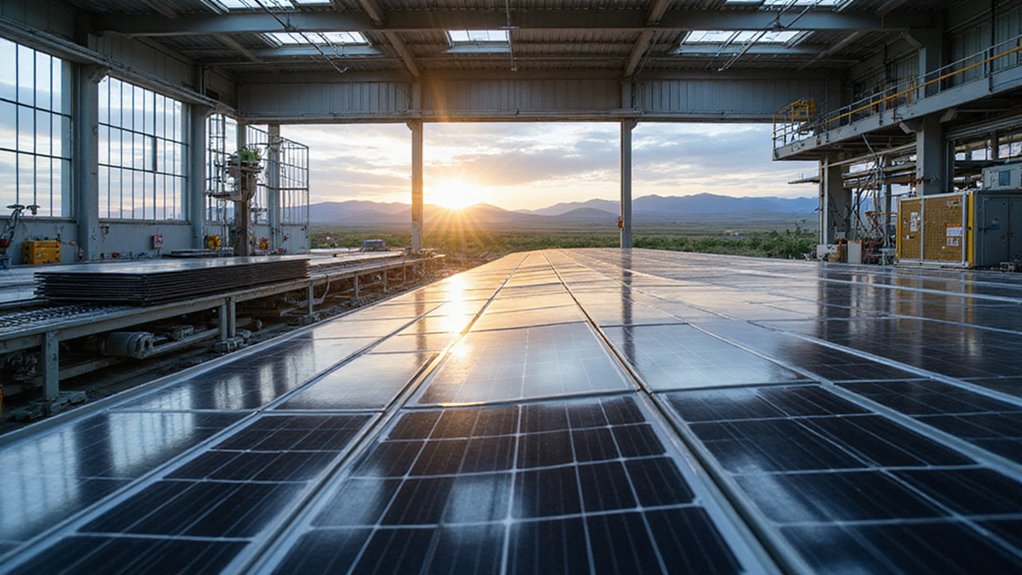
Here’s where it gets interesting. Argentina’s launching its first domestic solar panel factory, and this isn’t just another industrial ribbon-cutting ceremony. This factory represents a complete shift in how the country approaches energy independence. No more begging for imports. No more bleeding foreign currency. Just homegrown panels ready to blanket the sun-drenched western provinces. The momentum is building with YPF Luz’s massive 305MW El Quemado solar plant expected to power up by 2026.
The numbers tell the real story. RenovAr Program wants 10,000 MW of renewables, with 58 solar projects totaling 2,834 MW already moving forward. Trade associations predict 700 MW in new solar and wind capacity for 2025. Even YPF, the oil giant, started building a 300 MW solar park in 2022. When oil companies start playing with solar panels, you know something’s shifting.
But let’s be honest. Argentina set a 20% non-hydro renewables target for end of 2025, and they’re currently at 15%. Close, but not quite there. Historic underfunding and economic volatility keep throwing wrenches in the works. Grid infrastructure can’t keep up with capacity additions. Classic Argentina move.
Still, declining technology costs and new deregulation measures expected in early 2025 could change everything. Private investment legislation is coming. Financing barriers might finally crumble. The domestic factory will create jobs, build expertise, and most importantly, make solar accessible to a country that desperately needs it. With solar costs having decreased by 90% over decade, Argentina’s timing couldn’t be better for this renewable energy transition.
References
- https://www.netzerocircle.org/news/argentina-breaks-renewable-energy-record—but-the-2025-target-still-looks-distant
- https://www.argusmedia.com/en/news-and-insights/latest-market-news/2638419-argentina-s-renewables-to-get-boost-in-2025
- https://thedialogue.org/analysis/will-argentina-reach-its-20-percent-renewable-energy-goal-by-2025
- https://www.pv-magazine.com/2025/01/15/argentina-achieves-renewables-record-in-november-with-installed-solar-at-nearly-2-gw/
- https://www.mordorintelligence.com/industry-reports/argentina-solar-energy-market