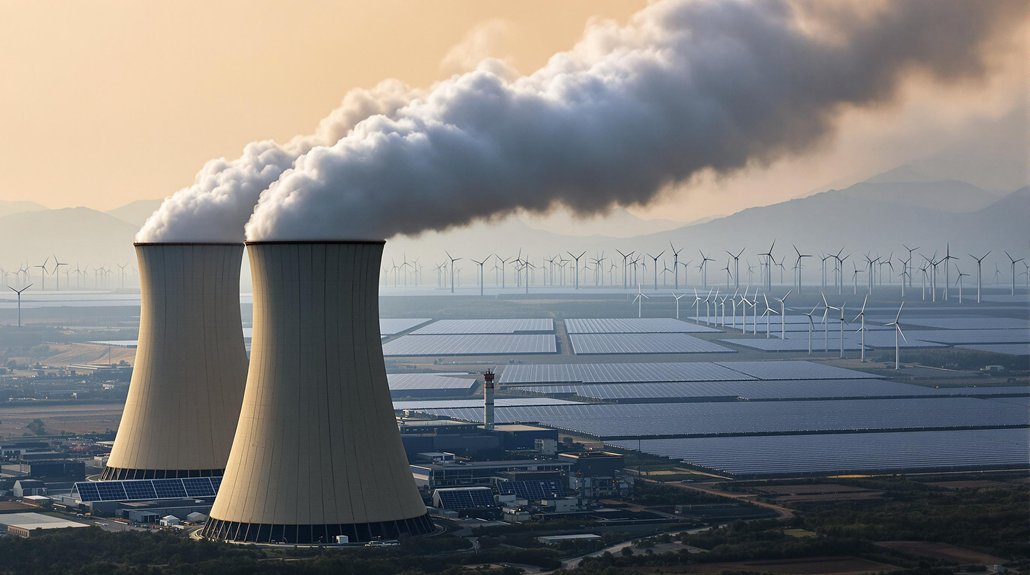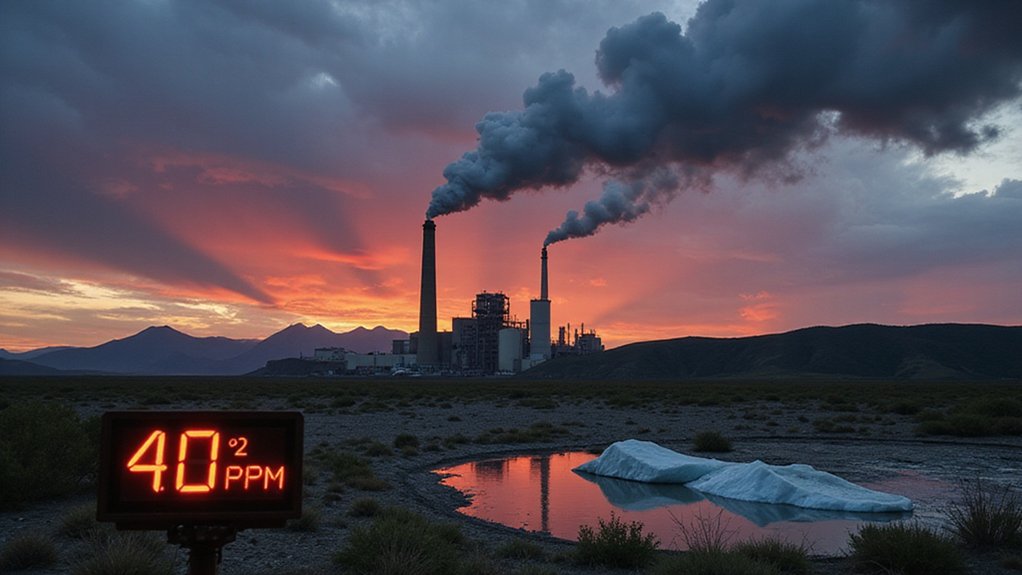

Why did the Early Triassic period turn into Earth’s most brutal sauna party? Scientists have finally pieced together this ancient climate disaster, and it’s a recipe for planetary destruction. The Siberian Traps Large Igneous Province wasn’t just your average volcanic activity—it was Earth’s most extreme makeover gone terribly wrong.
For 1.3 million years, these volcanoes released hell. But that’s not even the worst part. These eruptions had the misfortune of blasting right through coal and organic-rich sediments. Talk about bad geological luck. The magma literally set massive coal deposits on fire, creating a nightmare combo of volcanic gases plus burning fossil fuels. Early Triassic coal barbecues. Not cool. Mercury isotope signatures, especially positive shifts in Δ199Hg, provide critical evidence linking these events to volcanic sources. Just as with the later end-Triassic extinction, these events caused devastating global warming effects that dramatically altered Earth’s climate.
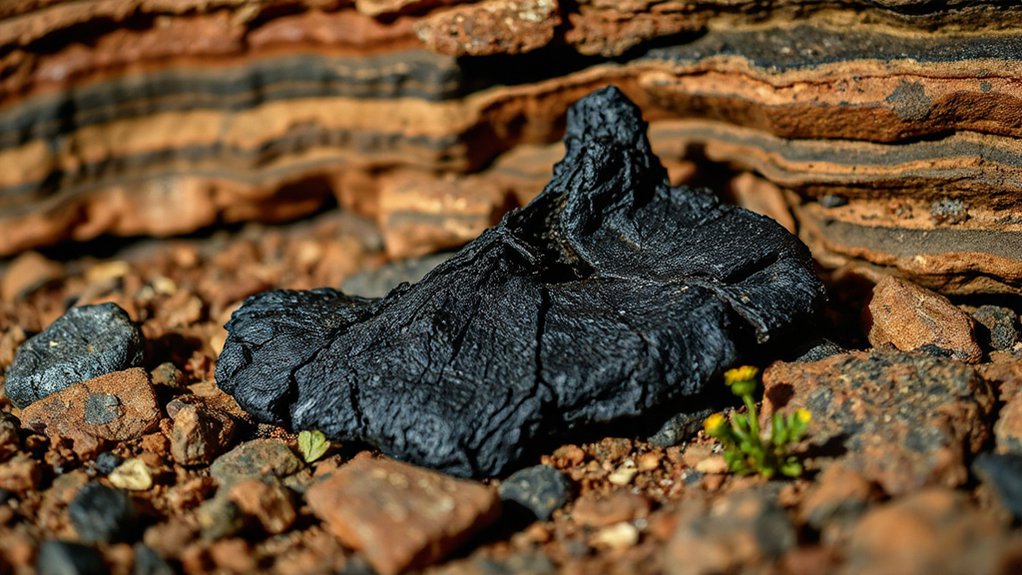
The evidence is everywhere. Mercury spikes in sediments worldwide. Volcanic ash beds. Polycyclic aromatic hydrocarbons—fancy science-speak for “stuff that proves things were burning.” They’ve even found direct evidence of charred coal near Russia’s Angara River. Smoking gun? More like smoking planet.
The results were catastrophic. Equatorial ocean temperatures topped 104°F. That’s bathtub temperature across entire oceans. Ridiculous. Up to 96% of marine species and 70% of land vertebrates went extinct. The planet basically rebooted life from scratch.
Ocean temperatures hot enough to poach marine life. Earth’s greatest extinction reboot—96% of sea species gone in a global sauna.
The disaster came in pulses, not all at once. High-precision U-Pb dating of zircons shows multiple extinction waves with slightly different causes. Sometimes land ecosystems collapsed before marine ones. The planet was so covered in dead stuff that fungi had a field day—scientists literally found a “fungal spike” in the fossil record.
Recovery? Don’t hold your breath. It took millions of years. The Early Triassic kept serving up extreme climate events like a sadistic geological bartender. Every time ecosystems started to bounce back—bam!—another volcanic pulse.
Earth’s greatest extinction wasn’t just a bad day. It was a million-year nightmare of fire, greenhouse gases, and acid oceans that reshaped life forever. Ancient ash and fire indeed.
References
- https://www.pnas.org/doi/10.1073/pnas.1705378114
- https://news.mit.edu/2013/volcanic-eruptions-triggered-end-triassic-extinction-0321
- https://www.nature.com/articles/s41467-022-35272-8
- http://ui.adsabs.harvard.edu/abs/2019ESRv..195..191S/abstract
- https://en.wikipedia.org/wiki/Permian–Triassic_extinction_event
- https://www.nsf.gov/news/volcanic-coal-burning-siberia-led-climate-change
- https://phys.org/news/2025-11-early-triassic-sediments-reveal-earth.html
- https://lamont.columbia.edu/news/dinosaurs-thrived-after-ice-not-fire-says-new-study-ancient-volcanism