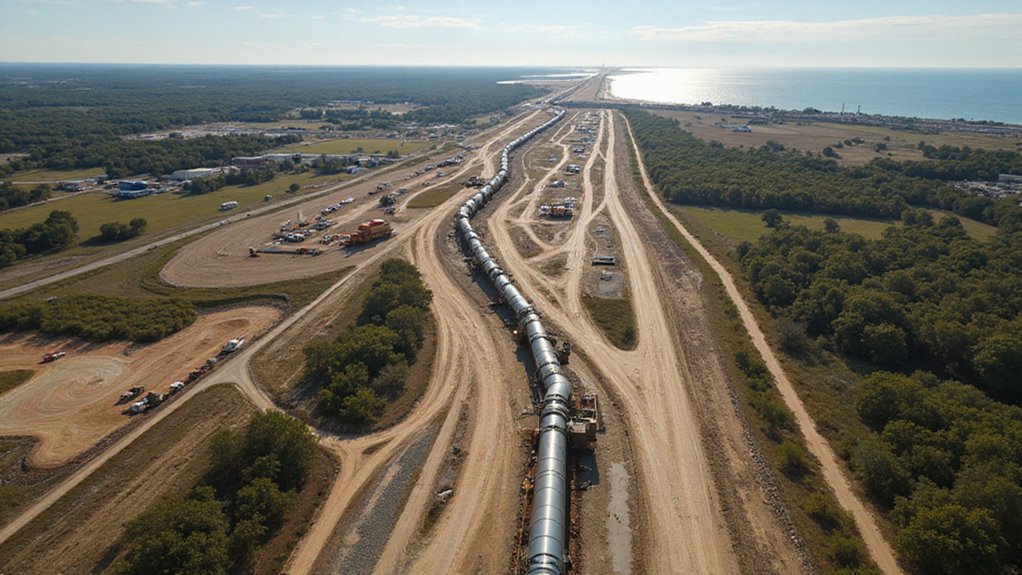

America is building pipelines like there’s no tomorrow. The U.S. oil and gas pipeline construction industry is set to balloon to $286 billion by 2031, with infrastructure investments already hitting $78.9 billion in 2024. That’s a 6.4% annual growth rate through 2034. Not bad for an industry some thought would be dead by now.
Here’s the kicker: most of this gas isn’t even staying home. Over three-quarters of new pipeline capacity under development is designed for LNG exports, not American stoves or power plants. The 10 largest planned pipelines? All aimed at shipping gas overseas. So much for energy independence serving Americans first.
America’s building massive pipelines to ship gas overseas, not power American homes.
The numbers are staggering. Natural gas pipeline completions in 2024 added 6.5 billion cubic feet per day of takeaway capacity in key regions. Five projects in Texas and Louisiana alone pumped up capacity by 8.5 Bcf/d for LNG export terminals. Smaller projects chipped in another 3.0 Bcf/d. Total new capacity in 2024 hit 17.8 Bcf/d, beating the previous year for the second time running.
Get this: planned conveyance pipelines would add 99 Bcf/d of new capacity. That’s nearly equal to all of America’s 2024 natural gas production. The pipeline boom is flourishing in Appalachia, Haynesville, Permian, and Eagle Ford regions, with Texas and Louisiana serving as the main export hubs.
The environmental crowd isn’t thrilled. Greenhouse gas emissions from this new pipeline capacity are projected to exceed those from every coal-fired power plant currently operating in the U.S. That’s right, all of them. In fact, CO2 emissions from these pipelines could be 2.5 times greater than those from all U.S. coal-fired power plants. Critics say it’s locking in fossil fuel dependence for decades, making renewable energy conveyances look like a pipe dream.
But the money keeps flowing. Construction jobs, local business growth, and massive revenue potential for gas producers are driving this boom. Export capacity means bigger profits. Interstate projects now outpace intrastate ones, all designed to move American gas from production basins to ships headed for foreign shores. This pipeline expansion contradicts global trends where renewable power capacity is expected to increase by over 5,500 GW between 2024 and 2030. Industry financial ratios show pipeline companies consistently outperforming other construction sectors, making this a lucrative bet for investors.
References
- https://infrastructurereportcard.org/wp-content/uploads/2025/03/Full-Report-2025-Natl-IRC-WEB.pdf
- https://www.globenewswire.com/news-release/2025/04/25/3068536/0/en/U-S-Oil-and-Gas-Pipelines-and-Structures-Construction-Report-2025-Analytics-Extensive-Financial-Benchmarks-Metrics-and-Revenue-Forecasts-to-2031.html
- https://insideclimatenews.org/news/02062025/us-gas-pipeline-buildout-mostly-for-export/
- https://www.gminsights.com/industry-analysis/us-oil-and-gas-infrastructure-market
- https://www.eia.gov/todayinenergy/detail.php?id=64744