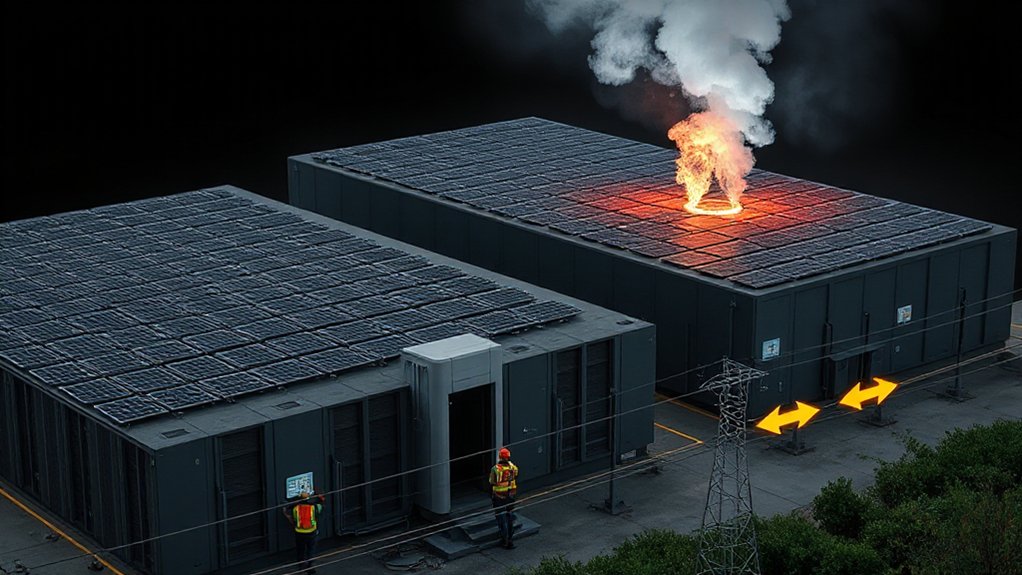
Irony sits at the heart of our AI revolution. The very technology promising to solve our most pressing challenges is gulping electricity at an alarming rate. Data centers already swallow 1.5% of global electricity—about 415 TWh annually—roughly matching what the entire airline industry consumes. And they’re getting hungrier.
The numbers are staggering. By 2030, these digital fortresses could devour 945 TWh yearly—nearly 3% of global electricity. In America, the situation looks even worse. Some experts predict data centers might gobble up to 9% of U.S. power supply by decade’s end. Half of this growth? Blame AI.
Let’s be real. Those cute ChatGPT responses cost about 2.9 watt-hours each—ten times more than a standard Google search. The GPUs powering AI training are power-hungry beasts, consuming four times what traditional CPUs use. No wonder electricity accounts for 46% of operational expenses in enterprise data centers.
But here’s where things get interesting. These AI workloads are weirdly “bursty.” They swing wildly between computation and communication phases, causing demand fluctuations of hundreds of megawatts within minutes. Utilities are noticing. These aren’t your grandfather’s steady power consumers.
This volatility actually presents an opportunity. Data centers could become grid stabilization resources through load modulation. AI training models like ChatGPT-4 consume electricity equivalent to powering 2.5 million homes for a year. Instead of constant strain, they could flex with the grid’s needs. New business models are emerging—training schedule marketplaces and dynamic pricing contracts designed around this burstiness.
Location strategies are evolving too. The old rule of building data centers near users is fading. Power availability now drives siting decisions. Enterprises focusing on energy-efficient architectures can deliver twice as many AI applications while gaining significant economic advantages. Training a single large AI model produces carbon emissions equivalent to five cars over their entire lifetimes.
The World Economic Forum calls this the “energy paradox” of AI. The same technology straining our electricity grids offers powerful tools to optimize renewable energy generation and improve grid management.
The question isn’t whether AI will transform our energy landscape—it’s whether we’ll harness this paradox to strengthen rather than overwhelm our power systems.
References
- https://www.informationweek.com/sustainability/the-ai-power-paradox
- https://www.esgdive.com/spons/the-ai-paradox-energy-crisis-in-the-age-of-data-and-ai/759235/
- https://interestingengineering.substack.com/p/the-ai-infrastructure-paradox-why
- https://www.opis.com/blog/ai-paradoxical-role-aiding-or-hindering-energy-transition/
- https://omdia.tech.informa.com/om139246/dcd-apac-brief-the-ai-power-paradox-can-data-centers-balance-growth-and-sustainability
- https://www.se.com/ww/en/insights/ai-and-technology/artificial-intelligence/sustainable-data-centers-beyond-it-powering-the-ai-future/
- https://www.hamiltonlane.com/en-us/insight/infrastructure-2025/power-paradox