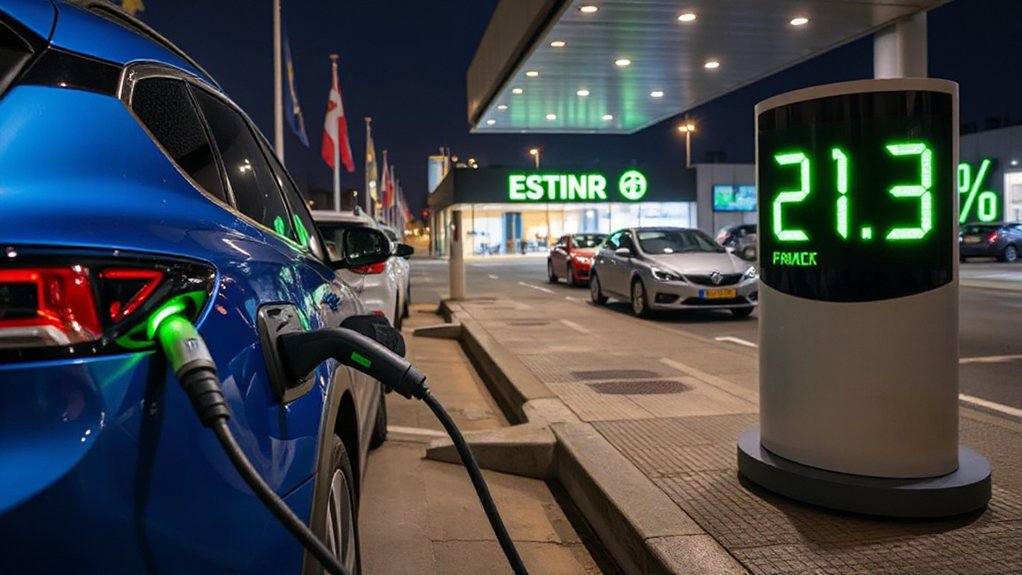

Battery-electric vehicles are steamrolling through the European market. November 2025 saw BEVs capture an impressive 21.3% of new passenger car registrations across the EU, with 188,730 new battery-powered vehicles hitting the roads. That’s a massive 44.1% jump compared to last year. Not too shabby for a technology that skeptics once dismissed as a passing fad.
The year-to-date figures hover around 18% market share, which means one thing: traditional automakers are sweating. And they should be. While the overall car market barely grew at 1.4%, BEVs are gobbling up what was once sacred ICE territory.
Four countries—Germany, Belgium, Netherlands, and France—are leading this electric revolution, accounting for roughly 62% of all EU BEV registrations. Germany alone saw BEV growth surge by 41.3% in November. Meanwhile, Poland is playing catch-up, showing rapid growth but still trailing the EU average.
Tesla and BYD are crushing it. These manufacturers are leaving traditional OEMs in the dust with their emissions compliance and BEV sales. Norwegian and Danish markets are particularly receptive to electric vehicles, with combined BEV and PHEV registrations reaching 97% and 69% respectively. Legacy automakers are scrambling to pivot, watching helplessly as their gas-guzzler market share evaporates.
The shift isn’t pretty. PHEVs and hybrids provide some breathing room for traditional manufacturers, but it’s just delaying the inevitable. Companies that dragged their feet on electric vehicles now face serious inventory problems and competitive disadvantages. Consumers want electric, and they want it now.
Supply chains remain the elephant in the room. Battery production, cell capacity, and raw materials are bottlenecks that keep executives up at night. Gigafactory investments are popping up across Europe as automakers desperately secure battery supply. The battery storage costs are expected to fall by 52% by 2030, potentially accelerating EV adoption even further.
The EU’s regulatory environment isn’t helping traditional players either. Strict CO2 targets are forcing the industry’s hand, driving up compliance costs for companies still clinging to their combustion-engine cash cows. Pure petrol and diesel vehicles have seen declines of over 20% compared to the previous year, highlighting the accelerating transition away from traditional fuels.
The message is clear: adapt or die. The electric revolution isn’t coming—it’s already here.