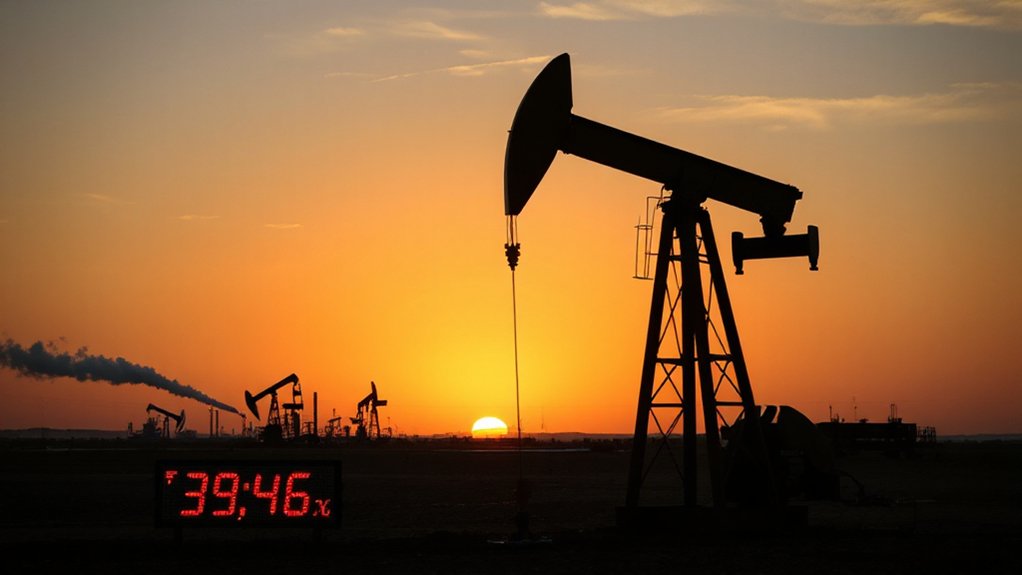

Towering above market turbulence, the world’s oil behemoths continue their relentless march forward despite headwinds that would crush lesser corporations. Saudi Aramco still dominates with a staggering $1.8 trillion market cap, even after shedding 15.4% of its value in a year. ExxonMobil follows at a distant second with $493.6 billion, while Chevron sits comfortably at $279.4 billion. These aren’t just big numbers. They’re economic kingdoms.
While nations tremble, oil titans forge ahead with economies larger than entire countries.
The production story? Even more absurd. ExxonMobil pumped a record 4.3 million barrels of oil equivalent daily by late 2024. Not enough, apparently. They’re gunning for 5.4 million by 2030. Chevron expects 6-8% output growth in 2025. As the largest US producer with 997,000 barrels per day, Chevron’s dominance in the Permian Basin continues to drive their market position. More, more, more.
The US remains the world’s largest producer, churning out nearly 23 million barrels daily in 2024 – that’s 22% of global production. Because why stop at “enough”?
Meanwhile, oil prices? Falling. Classic supply and demand having a laugh at everyone’s expense. These giants are literally pumping themselves into lower profits. Smart business strategy? Debatable. But when you’re this big, conventional wisdom doesn’t always apply.
The industry isn’t blind to change. ExxonMobil is throwing money at carbon capture systems, targeting 6.7 million tons of annual CO2 capture. PetroChina dreams of near-zero emissions by 2050. Shell expects 500,000 barrels daily from new projects through 2025. They’re betting on natural gas too – cleaner than oil, but still fossil fuel. Saudi Aramco continues this trend with its Jafurah project set to deliver 3.15 Bcf/d of natural gas by 2028. The contrast with geothermal energy, which produces 99% less carbon dioxide than fossil fuels, highlights the environmental cost of these expansion strategies.
Half-measures? Perhaps. But baby steps for trillion-dollar babies.
The global oil market sits at $20.2 billion in 2024 but could balloon to $95.7 billion by 2035. That’s a 15.19% compound annual growth rate if predictions hold. Despite environmental concerns, industrialization and urbanization keep demand strong.
These corporate giants aren’t going anywhere soon. Too big to fail? No. Too essential to ignore? Absolutely.
References
- https://straitsresearch.com/statistic/largest-oil-and-gas-companies
- https://www.joltly.io/blog/top-10-oil-and-gas-companies-based-on-us-crude-oil-production
- https://www.eia.gov/outlooks/steo/
- https://www.sphericalinsights.com/blogs/top-20-oil-and-gas-companies-in-global-2025-statistics-view-by-spherical-insights-consulting
- https://www.statista.com/chart/17930/the-biggest-oil-and-gas-companies-in-the-world/
- https://www.oilandgasiq.com/oil-gas/articles/the-top-10-oil-gas-companies-in-2025
- https://energydigital.com/top10/top-10-oil-and-gas-companies-2025
- https://www.deloitte.com/us/en/insights/industry/oil-and-gas/oil-and-gas-industry-outlook.html