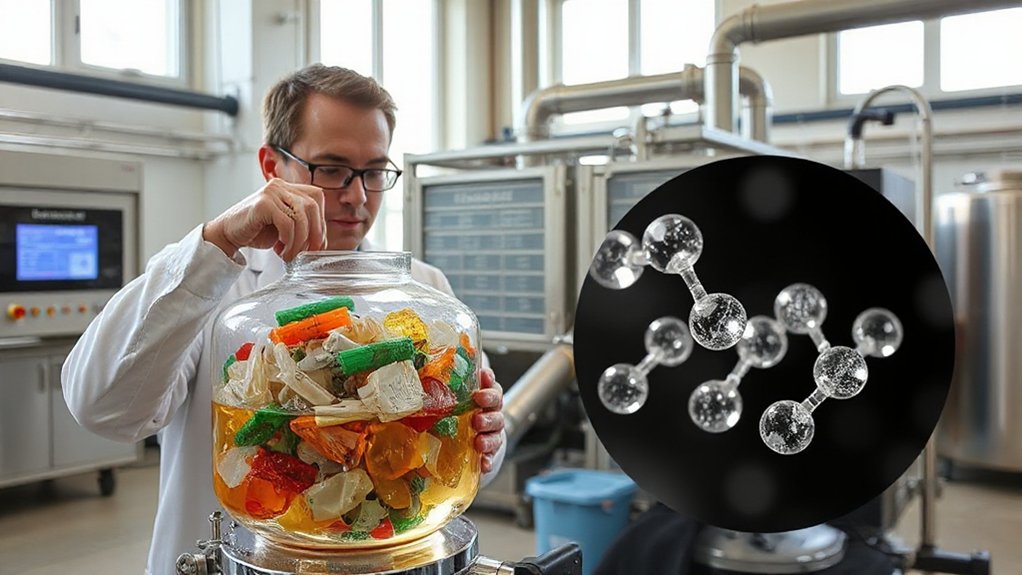

Countless plastic bags, bottles, and wrappers are choking our planet—but Delaware scientists just flipped the script. University of Delaware researchers have created a breakthrough catalyst that transforms pesky plastic waste into liquid gold—or more precisely, liquid fuel. Not just any catalyst. A game-changer that nearly doubles reaction rates compared to previous methods.
The magic happens through something called hydrogenolysis—fancy science-speak for breaking down plastics under hydrogen-rich conditions. Traditional catalysts struggle with bulky plastic molecules. They’re like trying to fit a beach ball through a doggy door. Not happening. Delaware’s solution? Create bigger pores in the catalyst using two-dimensional nanomaterials called MXenes. Bigger doors, faster flow. Simple, yet brilliant.
Bigger catalyst pores mean plastic molecules flow through like rush hour traffic when the lanes suddenly double.
This isn’t just lab-coat daydreaming. The catalyst specifically targets low-density polyethylene (LDPE), that stubborn plastic packaging we all throw away without a second thought. The innovative material consists of mesoporous MXenes-supported ruthenium that dramatically enhances conversion efficiency. Unlike the Yale process, this approach requires expensive catalysts with a limited lifespan, trading cost for performance. Now it’s becoming valuable fuel instead of ocean-choking waste. Mother Nature says thanks.
The economic implications are massive. Traditional recycling is like trying to unfry an egg—technically possible but practically useless. This catalyst gives waste managers a way to actually make money from plastic garbage. Turn trash into cash. Revolutionary.
How good is it? While Yale’s catalyst-free pyrolysis device converts about 66% of plastic waste, Delaware’s approach blows past that with double the conversion efficiency. Sorry, Yale. Numbers don’t lie.
For a planet drowning in plastic, this technology offers real hope. Less landfill waste. Reduced dependence on virgin fossil fuels. A circular economy that actually works. Similar to geothermal’s 96% capacity factor, this process demonstrates remarkable efficiency in transforming problematic waste into useful energy.
Big Oil executives are probably sweating. When the plastic waste they helped create becomes competition for their product, that’s what you call ironic justice. The petroleum industry created this monster; now they might get eaten by it. Poetic, really.