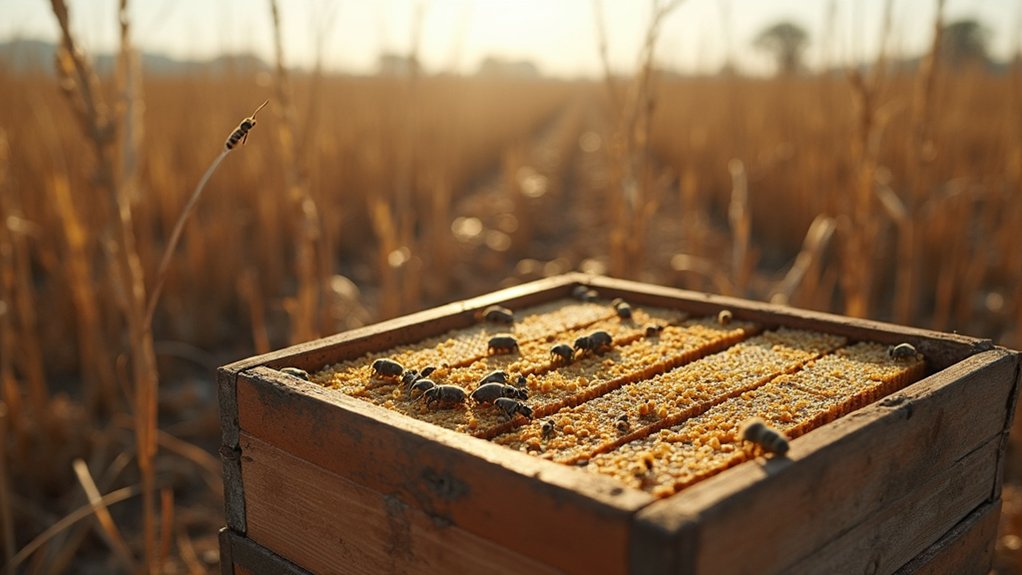

As the worst bee die-off in U.S. history continues unabated, American honey bee colonies are vanishing at an alarming rate. A staggering 55.6% of managed honey bee colonies disappeared between April 2024 and April 2025. That’s right—more than half. Gone. Just like your ex who promised they’d call.
This marks the second consecutive year of record-high losses, with some states reporting devastation as high as 90.5%. Commercial beekeepers are pointing fingers at winter conditions, but the truth is messier. Multiple factors are conspiring against these tiny pollinators: nutrition deficiencies, varroa mites running rampant, viral diseases, and pesticide exposure. It’s like bees are facing the apocalypse on multiple fronts. The agricultural industry is especially concerned as 35% of global crops depend directly on animal pollinators like honey bees.
The financial toll? A cool $139 million in losses for the apiary industry. But money isn’t the real issue here. These vanishing pollinators threaten our entire food system. No bees, no pollination. No pollination, fewer fruits and vegetables. It’s basic biology, folks.
We’ve seen something like this before. Remember the Colony Collapse Disorder scare of 2007-08? This is worse. CCD involved worker bees mysteriously disappearing while leaving their queen behind. Kinda like abandoning your boss at a company retreat—except with ecological consequences.
For a decade, losses averaged 40-50%. Now they’re approaching 60-70%. The survey revealed an alarming 40.2% winter loss, exceeding all historical records since tracking began. Not exactly trending in the right direction, is it?
Researchers and beekeepers aren’t giving up. Entomologists and bee vets are racing to find solutions, focusing on controlling those parasitic mites, understanding pesticide impacts, and improving bee nutrition. The USDA, universities, and nonprofits are all involved. Teamwork makes the dream work, and all that.
But while experts collaborate, the bees keep dying. Pollination demands aren’t decreasing—they’re growing. If this trend continues, your grocery bill might not be the only thing experiencing inflation. Food security itself could be at risk. And that’s not something any of us can afford to ignore.
References
- https://abcnews.go.com/US/honey-bee-colonies-face-70-losses-2025-impacting/story?id=120191720
- https://agriculture.auburn.edu/feature/u-s-beekeeping-survey-reveals-highest-honeybee-colony-losses-during-2024-2025/
- https://www.avma.org/news/mass-honey-bee-collapse-may-compromise-us-agriculture
- https://apiaryinspectors.org/US-beekeeping-survey-24-25
- https://bees.wsu.edu/2025colonylosses/