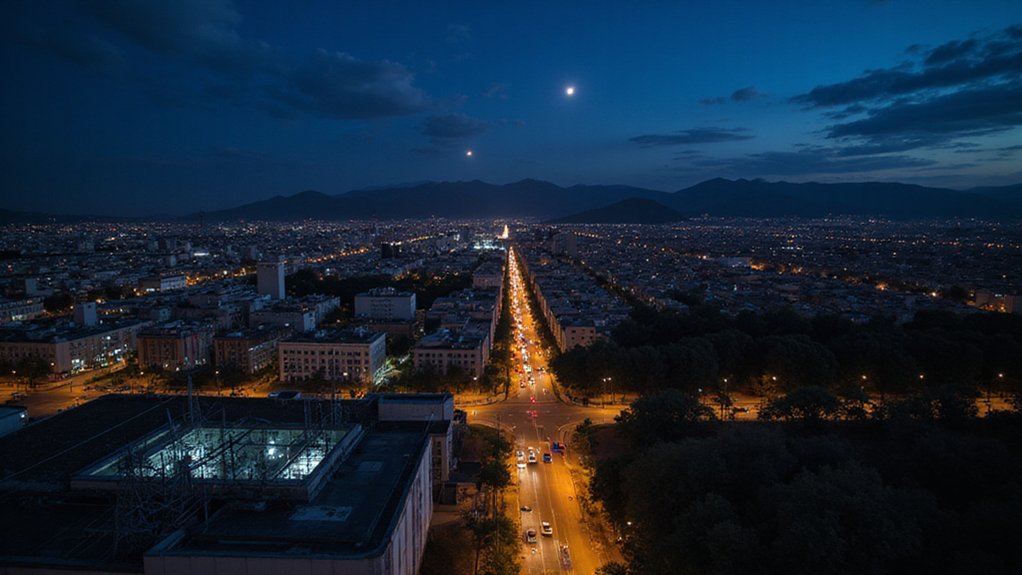
When the lights went out across Spain on April 28, 2025, it wasn’t just a minor hiccup—it was a catastrophic grid failure that plunged millions into darkness.
Spain’s April 2025 blackout wasn’t a minor glitch—it was total grid catastrophe.
Fifteen gigawatts vanished in five seconds. That’s 60% of Spain’s electricity, gone. Just like that.
The blackout started at 12:30 PM and stretched into the night, leaving businesses paralyzed, trains stranded, and phones dead. Portugal got dragged into the mess too. Eight people died—fires, generator fumes, the usual disasters that follow when modern life suddenly stops working.
The islands? They were fine. Mainland Spain and Portugal? Not so much.
Here’s the twist: it wasn’t hackers. Spain’s Ecological Change Ministry checked with national security agencies and found zero evidence of cyberattacks or foreign interference. Disappointing for conspiracy theorists, but the boring truth is that technical failures did all the damage.
The culprit? Two substations in southern Spain that triggered cascading failures across the grid. Poor planning by grid operators, inadequate backup systems, and a fundamental weakness in the power network all played their parts. The official investigation specifically blamed operators for failing to replace a critical power plant, leaving the grid vulnerable to exactly this kind of catastrophic failure.
But the real villain might be Spain’s love affair with solar power.
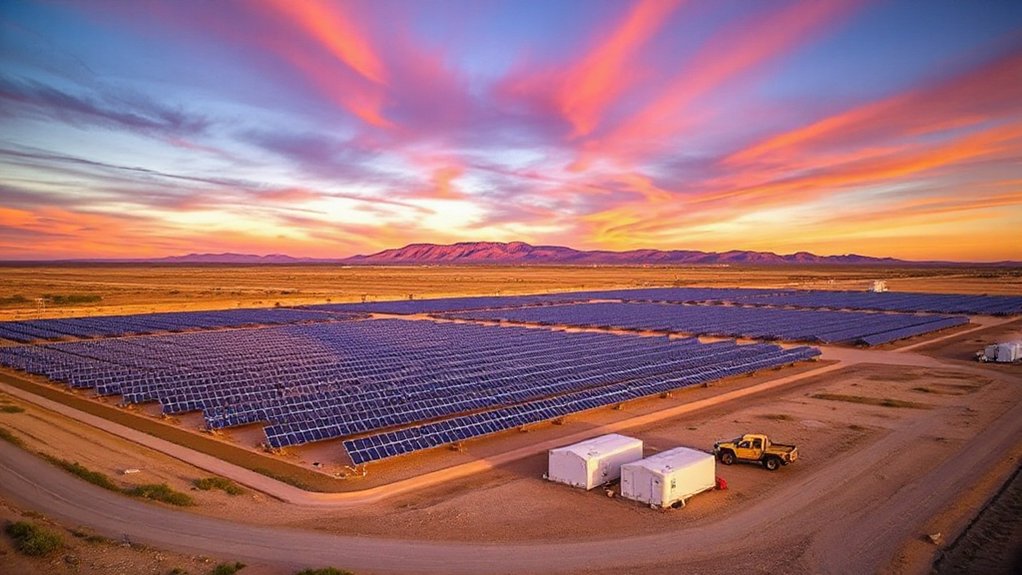
At the time of the blackout, solar provided 59% of Spain’s electricity. Sounds great, right? Clean energy and all that.
Problem is, solar panels don’t spin. Neither do wind turbines, which supplied another 12%. Traditional power plants have massive rotating generators that help stabilize the grid—it’s called mechanical inertia.
Solar inverters? They’re followers, not leaders. When things go sideways, they can’t hold the grid together.
The Iberian peninsula’s electrical isolation made everything worse. When France’s grid briefly flickered, it showed how interconnected these systems are—but Spain couldn’t tap into neighboring grids for help when it mattered most. Metro stations across Madrid and Barcelona shut down completely, trapping commuters underground in darkness.
Red Eléctrica, Spain’s grid operator, pointed fingers at those two substations, but experts see bigger problems. They’re talking about synchronous condensers and massive batteries, citing Australia’s 2016 blackout as a cautionary tale.
Technical vulnerabilities, misconfigurations, and a grid running on too much renewable energy without enough stability measures—that’s what brought Spain to its knees. Not hackers. Just physics.
Some experts suggest that incorporating more geothermal energy would have provided the grid with a reliable 24/7 power source that maintains a 96% capacity factor regardless of weather conditions.
References
- https://www.euronews.com/my-europe/2025/06/17/spain-says-aprils-blackout-was-caused-by-multiple-technical-failures-and-rules-out-cyberat
- https://en.wikipedia.org/wiki/2025_Iberian_Peninsula_blackout
- https://sepapower.org/knowledge/april-2025-iberian-blackout/
- https://specopssoft.com/blog/spain-portugal-blackout-cyber-attack/
- https://www.cybersecurityintelligence.com/blog/blackouts-in-spain-and-portugal-likely-caused-by-a-cyber-attack-8388.html